
The following article is a rough outline of a talk I gave at Literary Leicester on how writers inspire us to make a difference. My chosen writer was Graham Joyce.
Graham Joyce was born in Keresley, Coventry on 22 October 1954. But Leicester was his adopted home.
I first encountered Graham at The Writing Industries Conference in 2010 where he delivered the keynote speech, warning writers that the days of a hefty advance for their novels were over. Anyone serious about becoming a professional writer needed to diversify their output. Digital technology and social media were transforming the literary landscape. Best get involved than be left behind.
Graham was good to his word. He helped develop storylines for computer games, scripted the short film Black Dust, and cowrote song lyrics with Emilie Simon. He was eclectic with genre, writing horror, ghost stories and a form of speculative fiction which defied classification. Some see this as magical realism; I prefer to think of his words plucked straight out of the hedgerow. He described his work as having ‘the flavour of dreams’ but his novels are also grounded in family, relationships, and an infectious zest for life.
Despite his reservations about the financial rewards of novelists, he was incredibly successful. As well as winning the World Fantasy Award in 2003 for The Facts of Life, and collecting an O’ Henry Award in 2009 for the short story An Ordinary Soldier of the Queen, he was the winner of the World Fantasy Award for Best Novel five times. If he was a football team, his dominance of the genre would make him a Man City. A Pep Guardiola. Graham would appreciate this metaphor, but not the team. He was a Coventry City fan, occasionally writing for fanzines. He also played in net for the England Writer’s Football Team which he detailed in Simple Goalkeeping Made Spectacular.
So, why was he such a successful writer?
To answer this, you need to look at his life. He grew up in a mining village, worked at Butlins in Skegness, and spent ten years as a youth worker in Leicester where he believed the three R’s would get anyone back on track: Respect, recognition, responsibility. Each of these jobs and environments required an ability to connect with people. It’s this humanity which greets you on the page.
Graham was very much a writer who you could enjoy a pint with. He loved the energy of people and enjoyed sharing tales. He had courage and charisma about him. It’s this that led him to start an arts magazine in Leicester in 1980 with Sue Townsend who published a short diary entry about a certain ‘Nigel’ Mole. It was this that led him to quit his job as a Youth Worker in 1988 and drive to Lesbos with his girlfriend Sue, later to be his wife. They lived on a shack on the beach with no water or electric. But what he did have was the freedom to think and the time to write. One year later, his first novel, Dreamscape, was accepted for publication. Aspiring writers out there take note…
Graham was awarded a PhD by publication from Nottingham Trent University where he taught creative writing from 1996 up until his death. As fate would have it, I now teach parttime at NTU and occupy his former office.
In 2013 I began work on an online graphic novel serial called Dawn of the Unread which celebrated Nottingham’s literary history. Graham was one of the commissioned writers but soon afterwards was diagnosed with lymphoma. He passed away on 9 September 2014.
The following year I was in Leicester with Lydia Towsey who I had commissioned to host some writing workshops. During the break I popped outside for a fag and got chatting to a young woman and her mother about the project. When I explained that Dawn of the Unread was a celebration of dead writers and aimed to bring them back to life by encouraging people to read their books, the young girl, then seventeen, said, ‘My dad was a writer, his name was Graham Joyce, have you heard of him?’
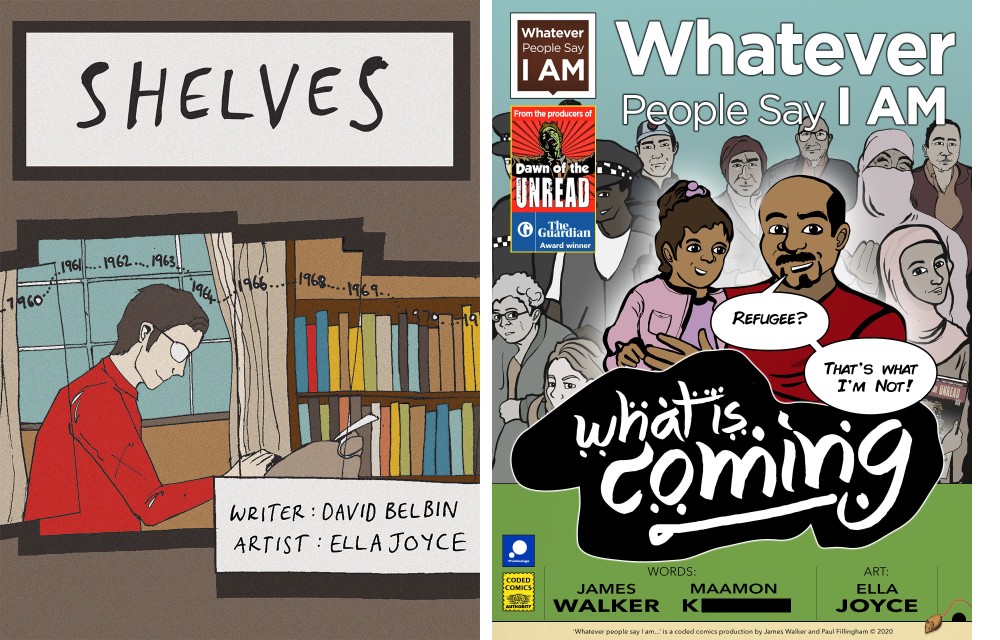
To cut a rather lovely and long story short, it turned out that Ella Joyce – the seventeen year-old women I was talking to – was about to start a Foundation in Art. I asked to see an example of her work and was absolutely blown away. I gave Ella her first commission and she illustrated the ‘Shelves’ comic in Dawn of the Unread.
I know that Graham would love the symmetry and peculiarity of this story. But he would also appreciate that youth had been given an opportunity. The commission gave his daughter respect, recognition, responsibility. We have since gone on to collaborate on Whatever People Say I Am, a series of comics challenging stereotypes.
 I’ve not read all of Graham’s nineteen or so novels. And this is deliberate. Books are precious. You can’t binge watch them like the latest series on Netflix. They need time to settle. I treat myself every three years or so to a new one. This year I will be reading The Year of the Ladybird.
In the last blog published on his website, Graham writes about the Anglo Saxon heritage of Wistow and how Charles Ist once galloped past here seeking refuge in Leicester. As he courts ghosts of the past, the Sence gently bubbles away on its way to meet the River Soar. He talks about his own mortality and ‘the shocking clarity that cancer brings’ only to discover later that a missile has randomly downed a plane in Ukraine and killed 300 people. This has more resonance today, given the current political climate. He then asks, ‘why anyone would want to die?’
It’s at this point a dragonfly whispers in his ear, ‘I have inhabited this earth for 3 million years old and I can’t answer these mysteries. Just cherish it all.’
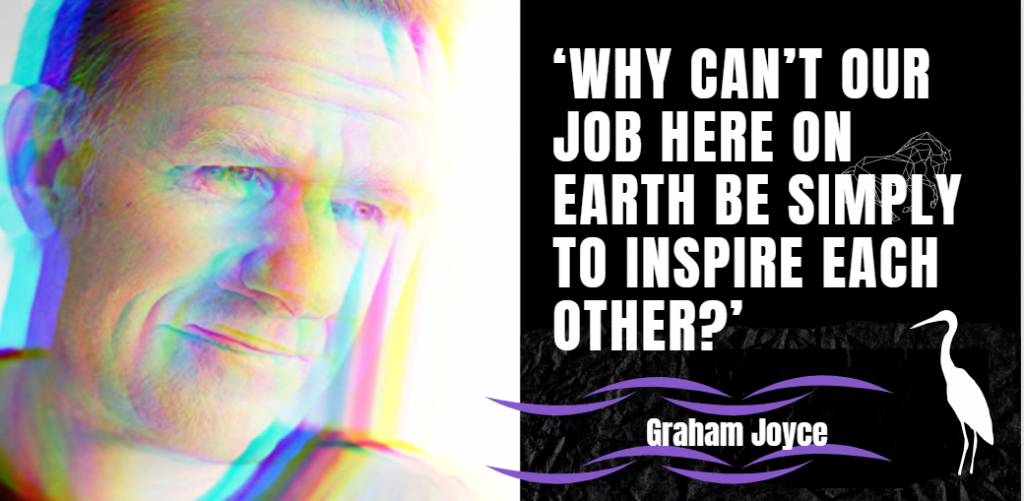
And then his old friend, the heron, appears, and asks: ‘Why can’t our job here on earth be simply to inspire each other?’
Let’s make this mantra in Leicester today. To inspire each other as Graham Joyce, Sue Townsend, Jean Binta Breeze, and other writers, have inspired us.
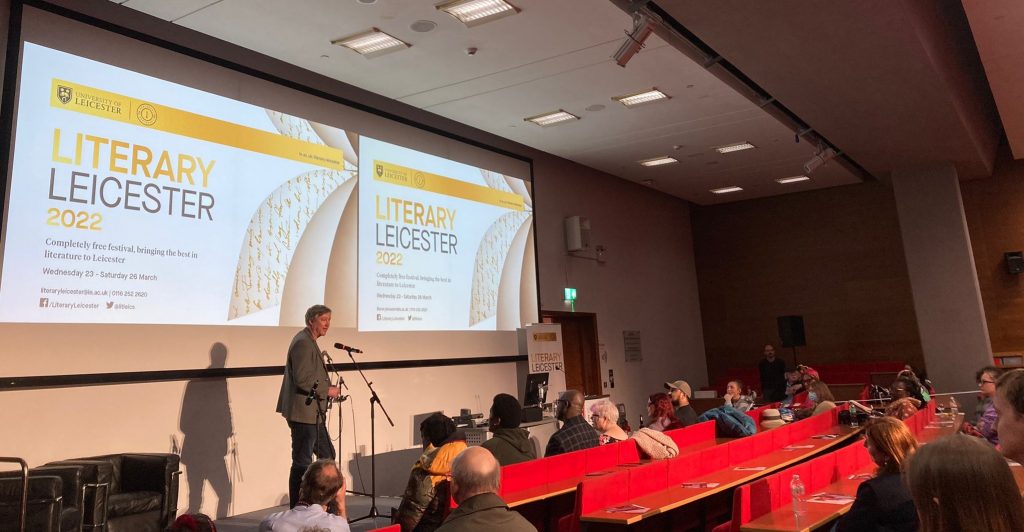
Photo: Aly Stoneman
Literary Leicester is an arts council funded festival that ran from Wednesday 25 March to Saturday 26 March. The above talk was given during the festival closing event, Mi Duck: Writers Changing Leicester
This blog also appears on the Dawn of the Unread blog