Cappuchaino

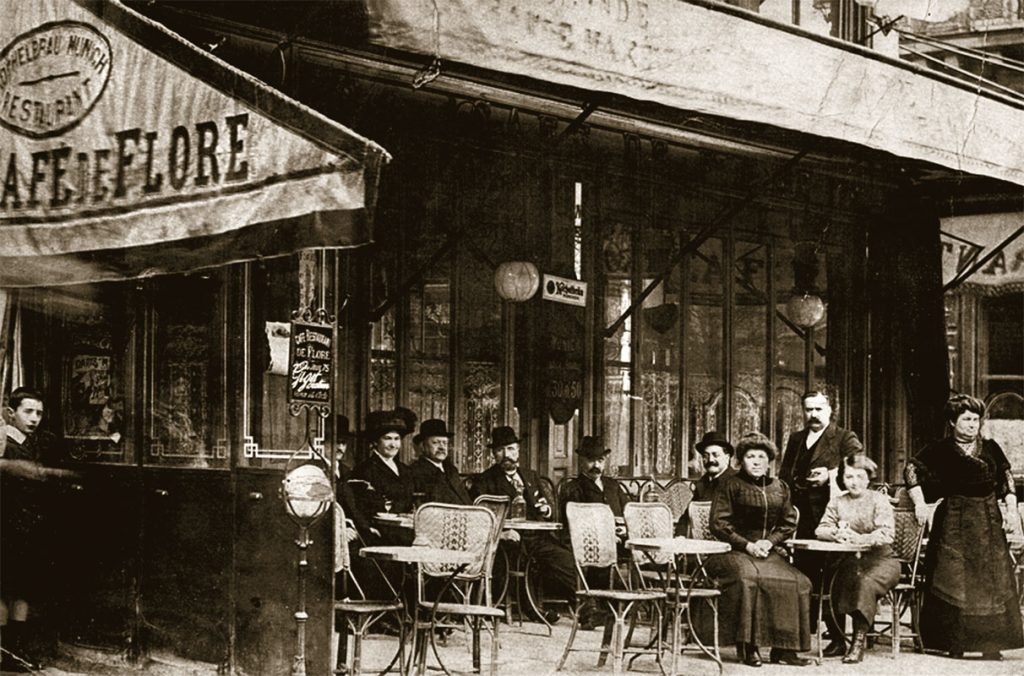
Cafe de Flore c. 1900. Image wikipedia.

Recently I met Jay Shah, the owner of a Coffee and Tea House on Carrington Street called Cappuchaino. She’s hoping the space will be used for roundtable discussions, spoken word performances, music events, festivals and other cultural activities that will draw in the local community. Cappuchaino has a diverse menu that caters for vegetarians, vegan, gluton free and halal. Where possible everything is sourced locally so there’s no need to worry about whether your sarnie was shipped in from Derby.

She’s an ambitious woman and a welcome (returning) face to Nottingham after spending eight years or so in Jack Straw’s constituency of Blackburn. Blackburn has received much negative publicity about its racial divide, famously captured by an estate agent on BBC’s Panorama who declared in 28 years of working in Blackburn he’d never sold a house in an Asian area to a white person. Although Nottingham has had its fair share of problems in the past it’s generally very tolerant and well integrated. Traditionally a factory city, Nottnum has never been dominated by one industry which has meant a diverse range of employment and with it a more varied outlook, albeit one that is united in its contempt for authority. This is fertile ground for her ambitions.

Nottingham has an incredible arts scene. We’re absolutely spoilt for choice when it comes to galleries, gigs and literature events. There’s a thriving DIY culture as well that sees a new event or business pop up on a weekly basis. So Cappuchaino has come to the right city. But with all of this creativity being shoehorned into the Creative Quarter, will people venture to a location on the periphery of the city?

Being close to the train station could be an advantage in picking up footfall, especially as our tourism figures are strong. According to figures produced by STEAM 2010 tourism to the city is valued at £466.4million and 1.38 billion countywide. Of this, 27.5% is spent on food and drink. Hopkinson’s is near by – easily my favourite location in Nottingham – so there is the potential to tap into this bohemian market that sounds very much like her target audience.

So what’s Cappuchaino like as a venue? It’s set over two floors and is a great performance space as all of the drinks are made upstairs (so you don’t get put-off mid-flow by a steaming coffee machine). They’ve got TV screens, meaning you can experiment with visuals or do a joint reading via Skype. At present, though, it looks too much like a chain to capture the vibe of a Café de Flore or Les Deux Magots. But this isn’t an issue as creating the right ambiance is easy: Switch off the lights, put candles on the tables, make sure none of your furniture matches, and regularly rotate artwork on the wall. They have wisely invested in a movable stage as well meaning the room can be tailored for your specific needs.

Jay is hoping to host her first Mushaira (urdu poetry) event for Nottingham City residents before the end of this year and is keen to speak to potential partners and planners who can offer support or advice. She is also keen to offer something additional to live events, so there’s possibilities for the pampering industries: henna tattooists, manicurists, masseurs, etc as well as local businesses with something relevant to flog. Bottom line: get in touch and make suggestions.

The recession has shattered the cultural landscape and reduced large funding for organisations. Very much like a jigsaw puzzle, it’s now a case of finding matching parts and recreating the image. Taking advantage of free rental space could be a useful platform for a new event without a budget. Drawing creative and complementary businesses into the equation offers the potential of shared revenue as well as a more dynamic event than your usual ‘gig’. So if you’re interested, Nottingham. Swing by and say hello to Cappuchaino and let us know how you got on.

Cappuchaino Coffee and Tea House  44 Carrington Street Nottingham NG17FG www.cappuchaino.com .


Digital Stories at Memories of the Future

Me impersonating fat Elvis. Taken and fiddled about in Photoshop by Video Matt for LeftLion's Decade ish.

Me impersonating fat Elvis. Taken and fiddled about in Photoshop by Video Matt for LeftLion’s Decade ish.

Now before you start, I haven’t gone all delusional and interviewed myself because I want a bit of attention. Honest. This interview was published on the Bees Make Honey CC website on 6 October. The interviewer is Kirsty Fox and it relates to a talk I’m giving at her analogue versus digital festival, Memories of the Future.

Next up in our DIY series for Memories of the Future is local writer & journalist James Walker. James will be doing a talk this Wednesday with his collaborator Paul Fillingham on ways in which writers can work with digital media. Interview: Kirsty Fox

Tell us a bit about your background as a writer & editor?

I started out writing fiction and had a short collection published with Route and have written a novel called This is All I Know which an agent is currently wiping his arse on. Although I love fiction I’ve pretty much spent the last decade promoting other people’s work as a literary journalist. Journalism is a great profession because you get to spend everyday meeting and listening to interesting or quirky people and discovering what makes them tick. There’s no better way to navigate a city than through the minds of its inhabitants.

I guess I’ve largely learned my trade at LeftLion where I’ve been the literature editor for the past eight years. When I first came across the mag I was disappointed at the lack of literature features and so I started to pester them, suggesting features and ideas. They eventually caved in and I created the WriteLion brand which has now expanded to two pages and features artists illustrating poetry, up to 9 book reviews and at least one literature interview per mag. Over the years I’ve done podcasts, spoken-word events and literature events at mini-festivals like the Canning Circus Carnival, Hockley Hustle and British Art Show. My favourite memory, though, is probably Scribal Gathering events like Gunpowder, Treason and Pot with Dealmaker. Who’d of thought you could get 200 people at a literature event?! From these I quickly learned a lot about the local community, discovering, for instance, beatboxers like MotorMouf, who would stay in the back of my head until I could find a spot for him in a future project.        

What have you & Paul Fillingham got planned for Memories of the Future?

Paul is going to spend the first twenty minutes discussing The Sillitoe Trail and literary heritage projects he’s created through his company Think Amigo. The second part I’ll be talking about Dawn of the Unread and mainly illustrating how you can take a book and broaden it to draw in work across creative disciplines. Afterwards we’re happy to have a natter with anyone who’s got ideas for a project and wants advice on how to make this happen. We love Nottingham and are really eager to help anyone who can make it a fun place to live in.      

How does the collaborative relationship work?

Usually there’s something that’s pissing me off about literature that means I can’t get to sleep so I call Paul up and we meet for a coffee. He’s like a digital therapist who is able to materialise my ideas. The fact that he’s an incredible artist as well is a bonus. The key to any collaboration, though, is trust. I never question his methodology because he knows what he’s doing, and likewise. Talking face-to-face is pretty important too. You can’t bounce ideas off each other over email. There’s no snarl and spit.

What is The Sillitoe Trail?

It was a commission for BBC/Arts Council multimedia platform The Space that can be viewed online, or downloaded as an App or ebook. Basically we took five themes from Alan Sillitoe’s Saturday Night and Sunday Morning (1958) and asked how relevant they were today. We got beatboxers, poets, historians, photographers, art students, jazz musicians, and writers to interpret these themes. Alan Sillitoe’s father was illiterate and so we wanted to illustrate how literature could be exciting and encourage reading. It really pisses me off that people are still leaving school unable to read. It’s unforgivable.

Tell us a bit about your plans for Dawn of the Unread?

The two factors pissing me off driving this project are: One, people know very little about Nottingham’s incredible literary history – something I realised after doing a literary walk with Michael Eaton for the Festival of Words. Two, Nottingham has been incredibly fortunate not to have any libraries closed down during the cuts and to prevent this happening in the future we need to ensure that people continue to use them. Dawn of the Unread is an interactive graphic novel spread out over ten chapters that will promote reading and local history and will hopefully get people into libraries via various cunning plans…

Do you feel a bit more optimistic about the life of independent bookshops now that Five Leaves have announced they’re opening one in Nottingham City Centre?

I don’t want to live in a world where supermarkets are the only place that people have access to books. This isn’t because I’m a literary snob, it’s because independent publishers can’t afford to stock their books at such a reduced rate and so get ignored. The opening of any independent shop – be it books, music or art – is fantastic news for any city because it means your money is going to a small business who want your trade and therefore they will do all sorts of weird things like talk to you when you enter their premises. And I love the location: Only in Nottingham could a bookshop open up opposite a Bookies.

How do you see Libraries developing as we move into the digital age?

Investing in new technology (iPads, interactive display walls, Apps) is one way in which this can happen. The  Library of Birmingham  is a great example of how buildings can utilise technology and space to become things of beauty that people are desperate to visit. As far as eBooks are concerned this depends on the greedy piglets in publishing who place profit above ethics. For example, publishing giants like Random House have increased ebook prices to libraries by 300 percent over the last year, as well as limiting the number of check-outs per ebook. This means libraries have to lease another “copy” when their electronic version reaches a certain threshold. Similarly eBook distributors such as 3M and Overdrive are charging libraries up to ten times more than an individual consumer would pay. So unless this abusive attitude changes, libraries might not be able to afford to live in the digital age. A bit of an oxymoron given eBooks cost nowt and can be replicated an infinite amount of times at no extra cost.

Tell us a little about Nottingham Writers’ Studio & why more local writers should join?

Writers are a weird bunch. They spend most of their lives locked away in the garret writing about life rather than experiencing it. The Studio reminds them what it is to be human (laughs). Local writers should join because they are writers. The publishing industry is dominated by agents scared of venturing north of Watford and so it’s really important Nottingham pulls together to change this vulgar prejudice. There’s also free booze and crisps at our monthly socials…

What are your hopes for the next Nottingham Festival of Words? 

On a personal level, more sleep and less meetings. On a public level, more public. Nottingham really needs to get behind events like this, both in telling us what they want, helping this happen, and then turning up to support it.

Many thanks to James for answering our questions & for his continued hard graft championing the local literary scene. You can find out more about the development of Dawn of the Unread at – www.dawnoftheunread.wordpress.com

Digital Stories is running at 5.30pm Wednesday 9th October at The Corner, 8 Stoney Street.

To even things out, here’s an interview I did with Kirsty Fox about Memories of the Future. A shortened version of this interview appeared in LeftLion 55