About James

James specialises in digital literary heritage projects. He spends most of his time in front of a computer screen writing about life instead of living it. Therefore, do not trust a word he says.

Review: A Modern Don Juan by Andy Croft/N.S Thompson (Ed)

moderndonjuan3Tales of the fictional libertine Don Juan have been told many times and date as far back as the 1630s with Tirso de Molina’s play The Trickster of Seville and the Stone Guest. Over generations he has transformed into the hero-villain of countless plays, novels, poems and, of course, Mozart’s opera Don Giovanni (1787). But it is Lord Byron’s epic satirical poem (1819-24) that has become most synonymous with the exploits of the legendary lothario. In this latest outing, 15 poets, including T.S Eliot prize winners George Szirtes and Sinéad Morrissey, give the tale a thoroughly modern setting, as skunk-puffing night-club DJ Donald Johnson stumbles from one romantic disaster to the next in a “drunk arcadia”. Along the way ‘Donny’ is transformed into everything from a Brussels Eurocrat to a reality TV celeb. His travels take him on a swanky yacht, into prison and most surreally, into outer space. When he heads into Europe he finds the Greeks need help with austerity rather than independence, though this is nothing compared to the pain he receives from a ‘holistic’ dentist…

Co-editor of the collection, Andy Croft, brings Donny into the ‘unheroic age’ where celebrities are fodder for the unforgiving gossip pages of tabloids, and fame is as transient as ever: ‘how quickly reputations all unravel,/From Cameron and Clegg to Jimmy Saville.’ He discusses our obsession with superheroes and warns that to understand the world of economics you need more ‘than someone in a mask from Marvel Comics’. This humour is brutally contrasted with social commentary on modern warfare, where returning soldiers face a very different battle as they adjust back to ‘normal life: ‘‘but there’s now twice as many in the can/ As there are serving in Afghanistan’.

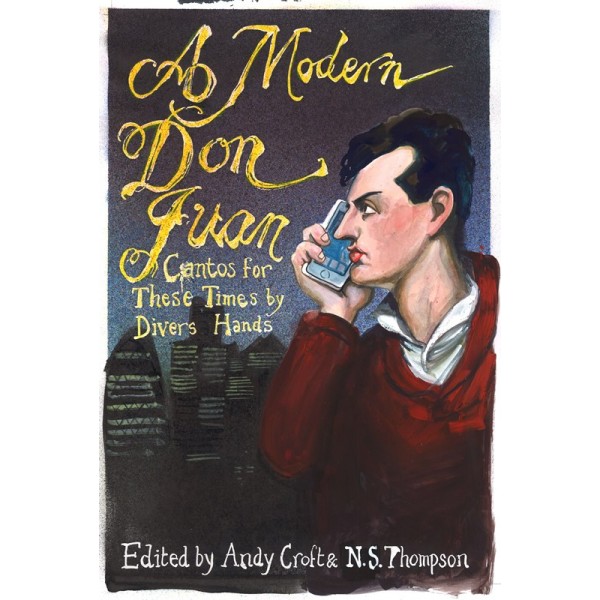
They say you shouldn’t judge a book by its cover but in this case you can. It’s a beautiful illustration by Martin Rowson that sees Byron’s ancestral home of Newstead Abbey replaced with a metropolitan cityscape and, of course, he’s on his mobile phone, no doubt lining up local conquests on Tinder. But it’s more relevant to judge a book by its readers. Five Leaves, the publisher, offered the book first ‘on subscription’, harking back to the way books were often sold in Byron’s time, demonstrating that there are many people out there who were eager to see this hapless seducer have one more outing.

 £14.99, Five Leaves

This review was originally published in the Morning Star on 20 December 2014

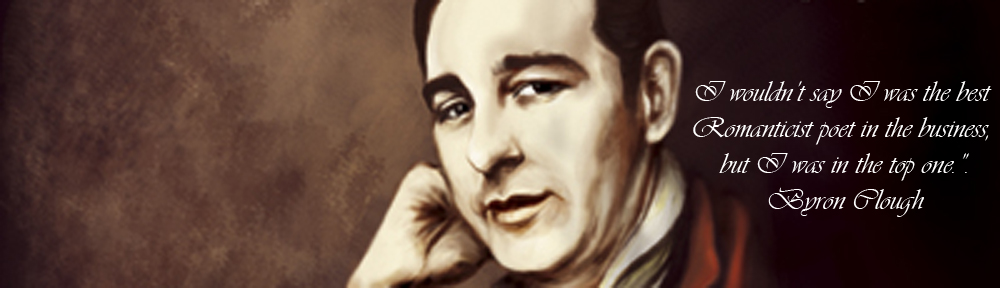
See Andy Croft’s poem about ‘Byron Clough’ in issue 5 of Dawn of the Unread

Being Arthur and Raphael Hefti

Being arthur

Artwork by Paul Fillingham.

This weekend saw Paul Fillingham and I produce the first ever live 24 hour Twitter presentation of Saturday Night and Sunday Morning for a project called Being Arthur as part of the Being Human Festival at the University of Nottingham. We billed this as The Sillitoe Trail II as it developed themes and ideas from our Space commission a few years ago.

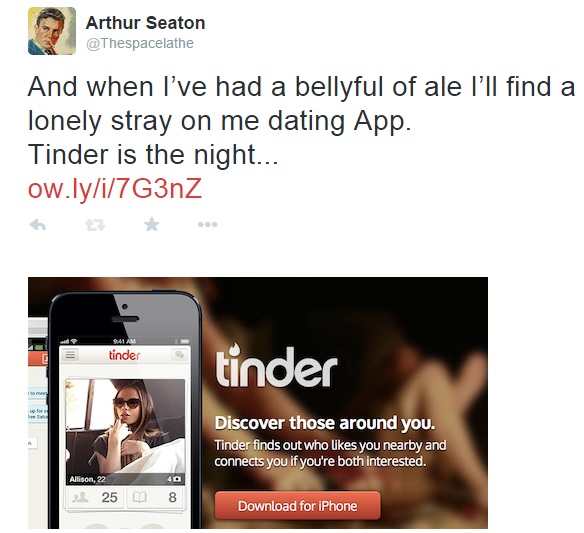
being arthur then and nowThe presentation was split into two parts: Then and Now. The script for ‘then’ was a combination of the novel, the screenplay, a few other Sillitoe novels and a bit of improvisation. ‘Now’ saw Seaton working his way through ‘nine hundred and fifty-bloody-four emails’, playing fishing on his wii because the canals have now dried up, and using dating App Tinder to meet lonely women because it’s cheaper and more immediate.

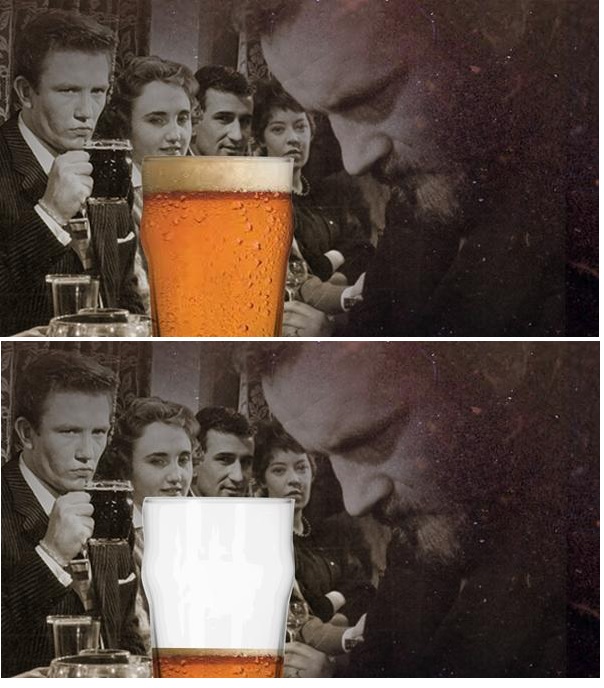
arthur pints

Artwork by Paul Fillingham.

It took a lot of research and time and was pretty much last minute due to other deadlines vying for attention. Paul created some beautiful visuals. I particularly liked the ‘drinking contest with the sailor’ as he visually created the slow, demolition of a pint. We created Twitter accounts for some of the other characters too, which was a right headache to properly synchronise so that it got tweeted in the right place.

One of the most pleasurable aspects of the project was getting comments from people who weren’t aware of what we were doing. As I’d used my personal Twitter account (TheSpaceLathe) for the modern Arthur, a few friends got quite concerned about the content of my tweets and thought I’d had some kind of personality change. I haven’t explained to them yet that I am not having a string of affairs as I’m quite interested to see if any of them start gossiping to my partner or spreading rumours.

tinder arthurBut using my personal account did restrict some of the content and meant I was more cautious than I should have been. One person on Twitter (@monsterlander) commented that the real Arthur Seaton would have laid in to noisy neighbours who woke him up (this is how the ‘new’ story starts) but as far as I am aware, Seaton didn’t really go around lamping people. There was always the threat of violence but he didn’t really instigate it. When he gets caught out by the squaddies it’s them that catch him rather than the other way around. But I was able to respond to this later on in the schedule by sending Monsterlander a threat.

It was a pleasant coincidence that Raphael Hefti’s exhibition was running at the Nottingham Contemporary at the same time as Being Arthur. Hefti is fascinated by processes and experimenting with materials. For his current solo exhibition he visited industries in the East Midlands, such as Rolls Royce with the aim of learning about the composition and treatment of metals in different states.

Arthur Seaton is a factory worker at Raleigh who grafts all day at his lathe for “14, 3 and tuppence for 1,000 of these a day”. Raleigh, during the period in which the book was set, was one of the largest employers in Nottingham, alongside Players and Boots. Sillitoe worked at Raleigh too, describing the daily grind as “a thousand times a day I set the bar, spin back the turret, push in the chamfer, force the drill. Working two cutting blades till the brass hexagonal nut falls into my right hand and gets thrown into a tin.”

Hefti, if you like, has taken these offcuts, these pieces of industrial waste from the production process, and given them new meanings through his experimental art. Instead of nuts he has used aluminium, titanium, copper and steel poles and heated them up so that they produce ribbons of beautiful colour. The artwork is entitled ‘Various Threaded Poles of Determinate Length Potentially altering their Determinacy, 2014’.

Both Seaton and Hefti’s artwork share quite a few similarities: Neither can be easily classified, they are both shaped by the industrial production process, and they equally strive to transcend their material existence. Seaton described his lathe as ‘my everlasting pal because it gets me thinking’. His imagination enabled him to temporary escape from monotonous, repetitious labour while defying anybody to try and grind him down. Hefti’s incredible artwork refuses to be pinned down and transforms industrial waste into something quite magical. But the similarities end there. Seaton would never be seen dead in some poncy art gallery, not even for a free cocktail on opening night.

RELATED READING