Radio Daze

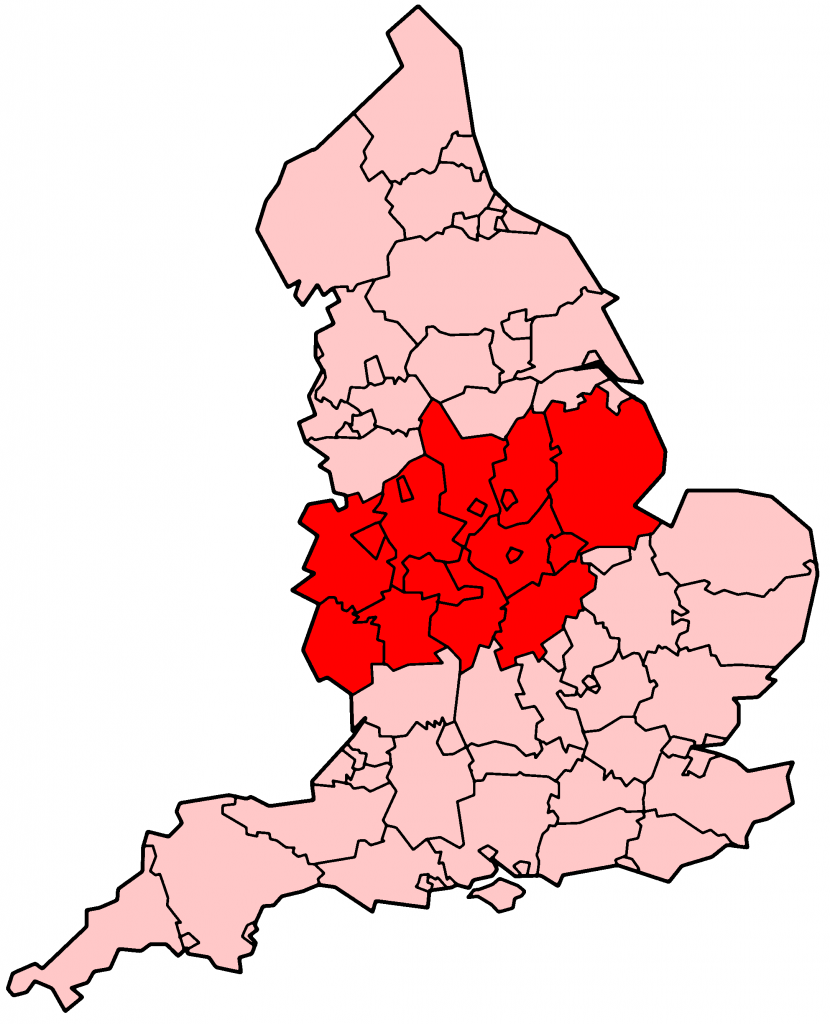
The Midlands, the tight belt keeping in the flab. Photo: Wikipedia.

Author Robert Shore contacted me through LeftLion a year ago about a book he was writing about the Midlands. His central argument is that the Midlands is a forgotten region and all cultural arguments position people as either belonging to the north or south. He was after a local phrase to capture this and I suggested Neither Use Nor Ornament, though he eventually went with Bang in the Middle. I was really intrigued by his book as it was much needed and so I explained, or rather confessed, how the last ten years or so of my life had been dedicated to promoting Nottingham culture and history from creating The Sillitoe Trail to my current project Dawn of the Unread.

A few months ago he got back in contact to tell me the book would be coming out in April (there is a review in the next LeftLion) and that after five years of trying, he’d managed to persuade BBC Radio 3 to commission a series of essays on the Midlands. He asked if I’d be interested in writing one.

I mention this as an important tip to aspiring writers. Most commissions come through people you know. This isn’t nepotism. It’s serendipity. I write for free for LeftLion but through this I get to meet lots of people within the industry. The digested read: You create your own fate.

I pitched various ideas to Robert and we eventually settled on ‘Whatever You Say I Am, That’s What I’m Not’: Arthur Seaton and Nottingham’s Rebellious Individualists. It’s the first time I’ve written for proper radio and had to quickly familiarise myself with the grammar, such as repeating various facts as the listener can tune in at any point. Then there was the usual caution of the BBC, such as recording two versions of a Sillitoe quote (with and without ‘bastard’) as well as explaining who Brian Clough was, just in case someone living in Malaysia was unaware of the footballing genius.

Alan Sillitoe, author of Nottingham's defining book Saturday Night and Sunday Morning

Alan Sillitoe, author of Nottingham’s defining book Saturday Night and Sunday Morning. Photo Dom Henry.

It was challenging to write as I needed to talk about Nottingham in the context of the Midlands, due to this being the theme of the collection of essays, while also exploring specific literary history and rebellion in Nottingham. As we have this in abundance I was spoilt for choice, which is some ways made it even more difficult. In the end I took Arthur Seaton as the main narrative thread and interweaved relevant points around him.

The word count for a 15 minute essay is about 2,200 words. Any more and you can’t get in the natural pauses and emphasis. I recorded this in London and had Robert, a sound engineer and the controller for Radio 3 in my earphones offering advice. One piece that was really useful was smile when reading relevant passages as it helps to change the tempo and rhythm of your voice.

I hate my voice and laughed when the controller politely asked if I’d ‘ham up’ the Nottingham accent when doing quotes. Our dialect is notoriously difficult to capture, just look at Russell Crow as Hood and Albert Finney’s Manc Arthur Seaton accent. And did he mean north or south of the Trent? Also, how could I ham up an accent when I’ve lived in Leeds, Manchester, Cambridge and have weird inflections from each? But it was more enjoyable than I thought it would be thanks to some professional guidance. Hopefully I won’t sound too much of a numpty and Al Needham, the master of local vernacular, won’t give me a hard time. 

The essays come out around the 24 April. The four contributors are Geoff Dyer, Henry Hitchings, James Walker and Katherine JakewaysBBC Radio 3 The Essay website

Preview in the Guardian

Interview with producer Robert Shore

Kick-starting your writing project

setup

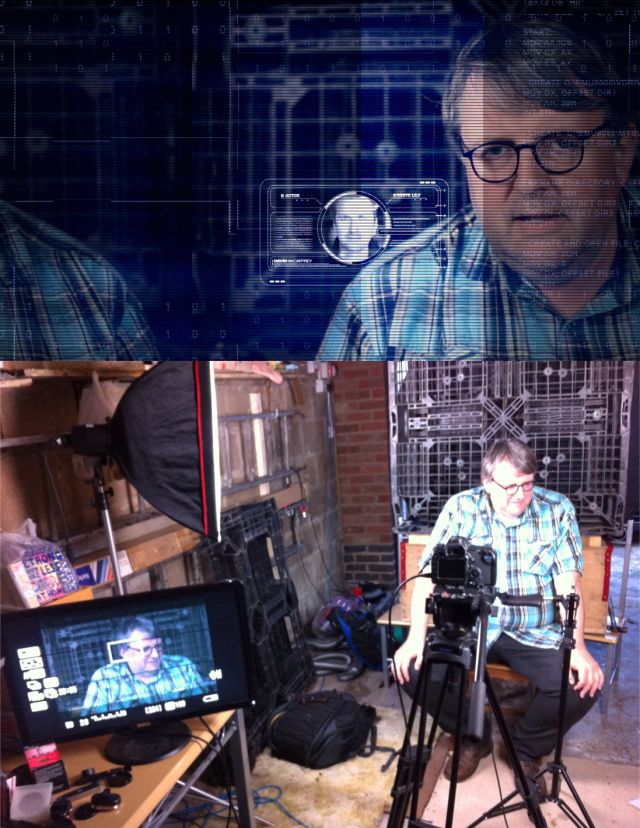
Adrian Reynolds successfully raised funds for White Lily through Kickstarter. Image from Kickstarted campaign.

Once upon a time there was a world full of generous benefactors who would happily fund an entire project. All you had to do was write a hand-written letter or fill out a small form and a lorry would deliver bundles of coins to your doorstep. Then the world changed. The rich benefactors fell off a mystical ledge known as the fiscal cliff and the pages of arts council forms multiplied faster than bacteria. The money dried up, people sat at home getting depressed and then the internet came up with a solution.

Crowdsourcing is one of the most viable means of funding a project. The formula is simple: no forms. You tell people about a project you want to do and then they pledge small donations of support which can range from £5 to £5million. Essentially this isn’t a new idea. It’s the old subscription model that funded writers like Whitman and Twain with a digital twist and a global reach. There’s loads of these sprouting up but I want to concentrate on one in particular, Kickstarter. Since Kickstarter’s launch in 2009 over 5 million people have pledged $826 million to fund 50,000 creative projects. The only problem is this is a shit or bust venture e.g. If you don’t raise your targeted amount in the allotted time you lose the lot.

Kickstarter has a 44% success rate. This means the other 56% of people were either unrealistic with how much they wanted to raise, their campaigns were poorly marketed or the great technocracy simply didn’t like what was on offer. But it certainly seems to work for certain art forms.

In 2012 there were 1,170 comics projects launched of which 542 were successful. An intriguing article in Publisher’s Weekly suggested that Kickstarter is the second largest independent publisher of graphic novels based on revenue. These figures are calculated on the percentage that goes directly to the project in comparison to say the split with a publisher. Take cartoonist Rich Burlew. He originally hoped to raise $57,500 to reprint out-of-print books collected from his “Order of the Stick” webcomic. Incredibly, he became the third person to raise over $1 million. At this point half of the readers of this blog have migrated to a crowdsourcing website. Good luck.

For those of you who still have an attention span and are prepared to trawl through the remainder of this article, here’s a few tips on how to conduct a successful campaign. I’m going to use Adrian Reynold and Tristan Ofield’s Kickstarter campaign White Lily as an example as this article is partly inspired by a recent talk Adrian gave at the Nottingham Writers’ Studio as part of Memories of the Future.

Preperation: Befriend anyone and everyone on Twitter and Facebook so that you have a bigger following than the latest football club to be bought by a rich oligarch. This means that when you start to ask for money, you have more people to spam than your family and uni mates. (please note: I’m a semi-purist and don’t adopt this technique. I only befriend everyone related to my interest/specialism)

Wit: Just because you can type doesn’t make you a writer. Get someone in who knows what they’re doing. People are more likely to hand over cash when you make them smile. In White Lily a £5 pledge gets you: “Instant Karma. You’re assured a place in our hearts, along with a financial credit on IMBD.” That’s shorthand for nada.

Goodies: People are kind but you’re more likely to get money out of them if you offer something desirable. This is why graphic novels do so well. A £15 donation gets you a comic that otherwise would have sold for £5. It’s like a shop with a high mark-up with the money going to an imaginary best friend.

Vanity: For enticing higher bidders you need to offer something special. If you’re doing a film, maybe someone can have a walk on part. Perhaps one of the artists on the project will create a unique signed one-off print, etc.

The magic key: 10% of films funded at Sundance in 2012 were funded through Kickstarter. Lots of producers will now pledge cash because they want to find the next best thing. That DVD you’re lobbing their way could lead to a big contract. That comic you’ve just drawn might get snapped up by DC. As much as this project is about raising money it’s also about raising your profile.

There’s loads more tips but you’ve got to do a bit of work yourself, like thinking of how you’re going to schedule content, who’s going to appear in that short sharp one minute video and most importantly, what it is that you need the money for.