UNESCO Nottingham: Home of books, burgers and balls

dotu-05-depiction-608p

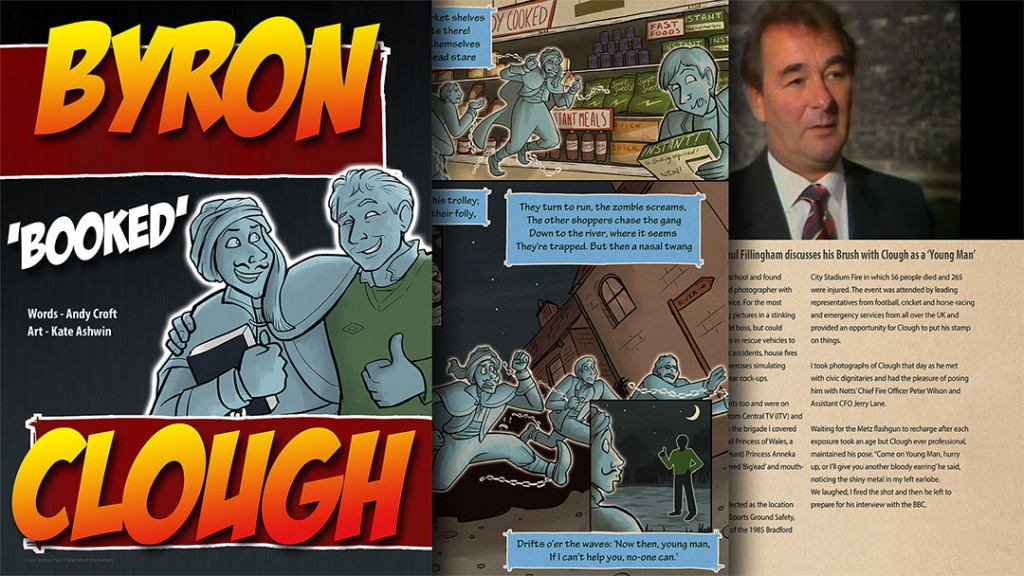
Layout design by Paul Fillingham. Football and literature featured in Issue 5 of Dawn of the Unread

I’ve left Nottingham five times but somehow always ended up back here. Now is a good time to be living in our little ode factory town because the place has absolutely transformed over the past two years. On one level, it would appear we’ve all grown four stomachs as we’re awash with restaurants. Where there was once a cinema on every street, now there’s a gourmet burger bar. It’s only a matter of time before the powers that be convert the Broadmarsh Centre into a giant vat of curry so we can swim and fart our way into the centre.

Three significant things have happened this year. We were named City of Football which will mean a lot of new sporting grounds pop up so you can burn off all of those burgers. The City of Football title also means a lot will be done to address gender equality in sport, something I’ve written about for their blog and linked to gender inequality in the arts.

On Friday 11 December, Nottingham was accredited as a UNESCO City of Literature. Instead of shouting at other people and telling them what they’re doing wrong, we’ve finally decided to stand up and shout for ourselves. The effect has been immediate and so I’m delighted to announce I’ve restarted the WriteLion literature podcast. It’s going to be co-hosted by Mouthy Poets, the Nottingham Playhouse and me and will be broadcast on the last Friday of each month to tie in with the publication of Leftlion.

Our new monthly literary podcast to celebrate the City of Literature accreditation.

Artwork by LeftLion. Our new monthly literary podcast to celebrate the City of Literature accreditation. You can listen to it here. 

Finally, Dawn of the Unread won the Teaching Excellence Award at the Guardian Education Awards in March, further validating our literary history. I was also shortlisted for the Outstanding Individual Award at the Education Investors’ Award in November. But more of that in a future post if I get time.

To celebrate the City of Football and City of Literature successes I’ve created my dream literary football team for the December issue of LeftLion. I’ve been meaning to do this for ages but finally had a valid excuse. I didn’t include DH Lawrence because he would be ranting at the ref and would get sent off. There was no place for Byron either, those tight shorts would have been too much of a distraction and I can’t imagine he’d have been much use with that club foot of his. Sillitoe is absent, too, as he didn’t like football and his only football related story, The Match, sees a Notts County fan take his frustrations out on his wife.

One person I had to include was Ioney Smallhorne who produced the video above. I got really upset last time I met her as she shared her frustration of being unable to find work as a film producer in Nottingham after having great success in Jamaica. Ioney perceives this may be due to institutionalised racism and I think she has a point. Racial equality will be one of the key areas I’ll be addressing through the City of Literature board as well as in other projects next year, having learned so much through the final issue of Dawn of the Unread where we met George Powe, George Africanus and the Nottingham Black Archive.

Chris Richardson is the author of City of Light, one of the greatest historical accounts of Nottingham ever written and so he was another immediate selection in my literary team. I hope more people google this polite and unassuming man and pop a copy of his account of Chartism, Socialism and Trade Unionism in 19th century Nottingham into their xmas stocking.

So here it is. Notts very own literary football team with a typo in Sweeper. My captain is Michael Eaton, a real inspiration with an unbelievable knowledge of his home town.
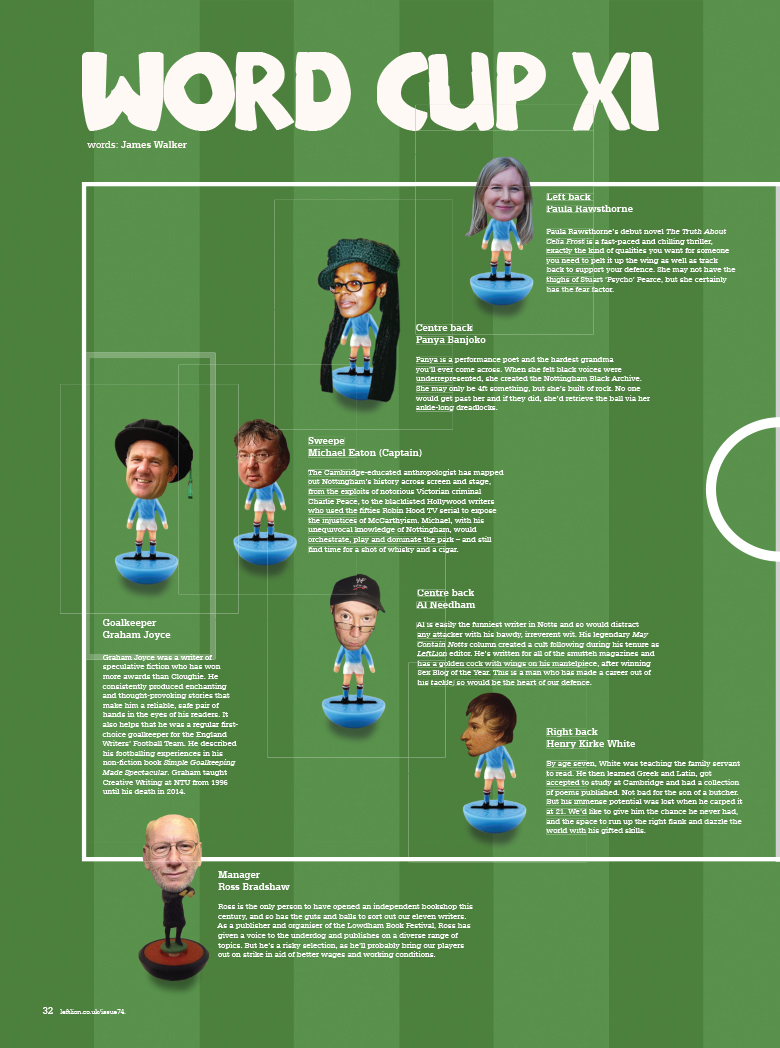
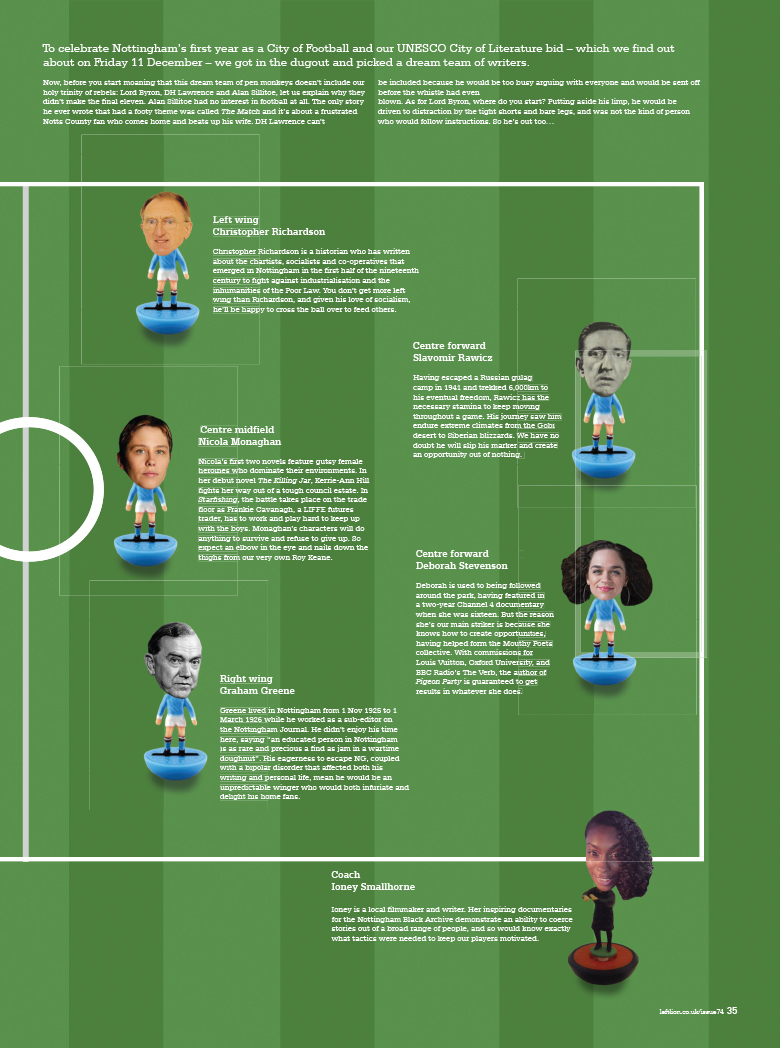
LEL032-UNESCO1

LEL033-UNESCO2

#MondayBlogs Nottingham’s Literary Streets

Photo taken from www.sillitoe.com

For a provincial city, Nottingham has an incredible literary history. When you arrive via train into the orange bricked Victorian station you are immediately greeted by a banner proclaiming our three most famous ‘rebel’ writers: Alan Sillitoe, Lord Byron and DH Lawrence.

Sillitoe’s debut novel Saturday Night and Sunday Morning (1958) was the first novel to give an authentic voice to the working classes through the eyes of hard drinking, womanising Arthur Seaton. It would become Pan’s first paperback to sell a million copies.

Lord Byron, whose ancestral home of Newstead Abbey is set in a glorious landscape of gardens and parkland north of the city, fought for the underdog in the Greek War of Independence as well as at home. In his maiden speech to the House of Lords he stood up for the 1811 framebreakers who were demonstrating against diminishing wages and faced lengthy prison sentences. Byron famously argued: “Can you carry this bill into effect? Can you commit a whole county to their own prisons? Will you erect a gibbet in every field and hang up men like scarecrows?”

DH Lawrence, whose home at 8a Victoria Street, Eastwood is now a Birthplace Museum with regular talks and literary walks, would pave the way forward for greater freedom of expression after the acquittal of Penguin Books in the Lady Chatterley Trail of 1960.

hungry

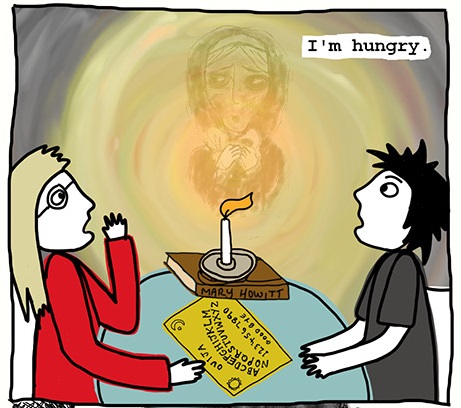
Mary Howitt is brought back to life in Nottingham’s literary graphic novel Dawn of the Unread

But Nottingham is also home to Quaker poet Mary Howitt who translated the works of Hans Christian Anderson and was one of the first writers to offer dietary information to the working classes through a journal she co-wrote with her husband William. You can find a bust of the Howitt’s at Nottingham Castle or read her books at Bromley House Subscription Library, which celebrates its 200th anniversary in 2016.

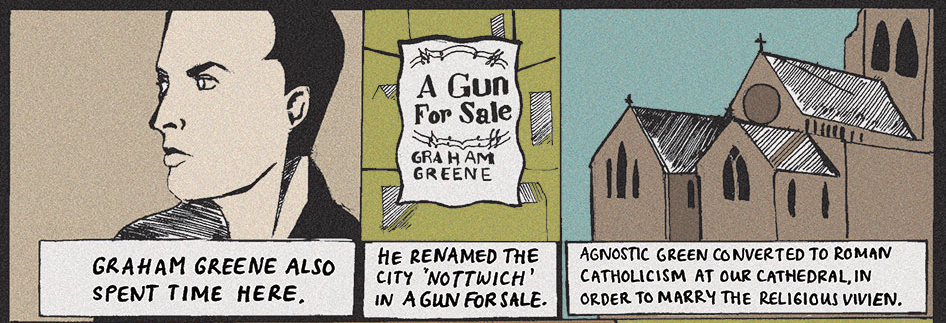
Graham Greene converted to Catholicism during his short stay in the city and trained as a journalist at the Nottingham Express Offices on Upper Parliament Street. The building has a distinctive style having been designed by local architect Watson Fothergill. Incorporated into the entrance are the busts of three leading Liberal politicians of the day – Cobden, Gladstone & Bright.

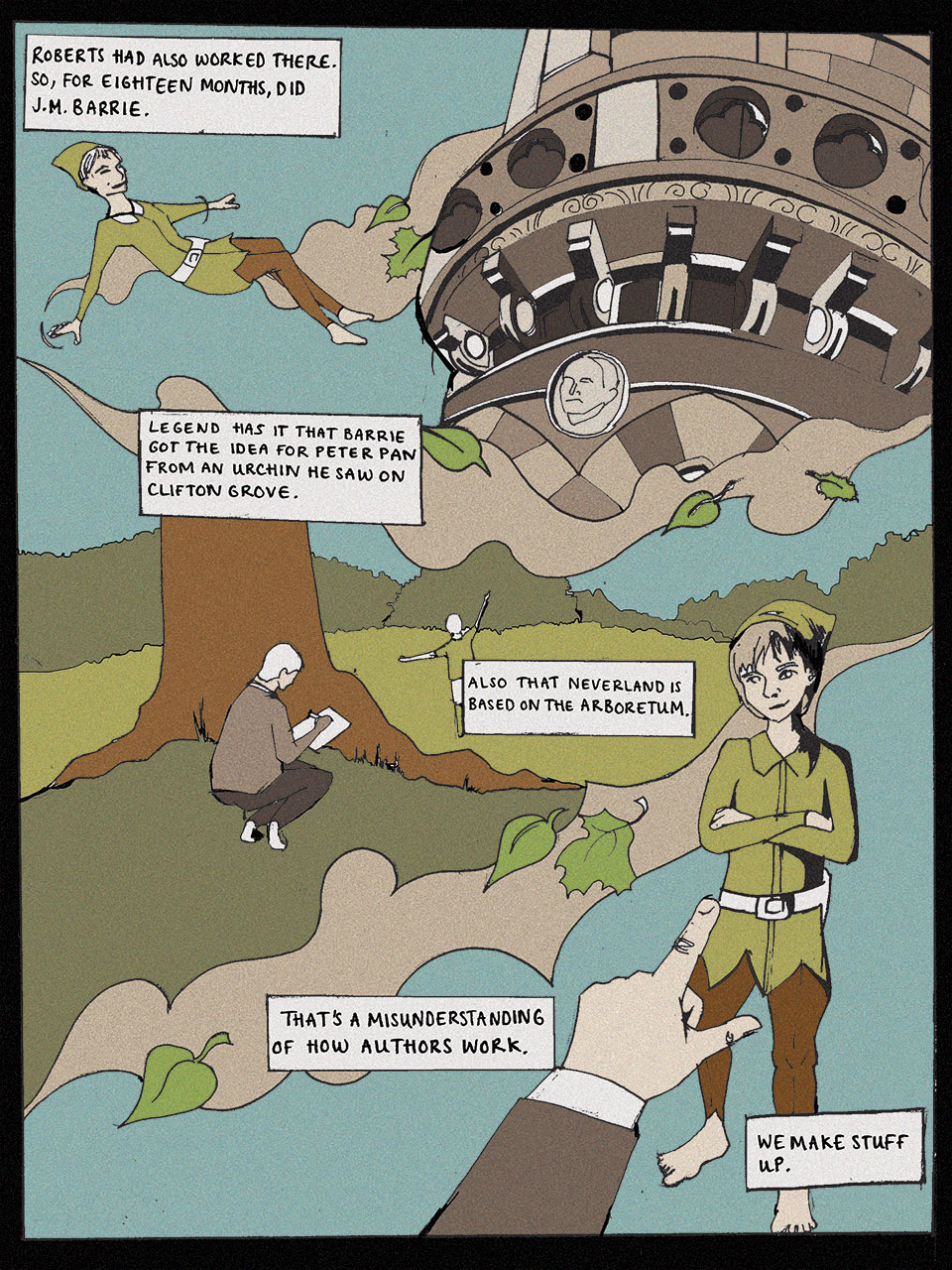
J.M Barrie makes an appearance in issue 14 of Dawn of the Unread

J.M Barrie makes an appearance in issue 14 of Dawn of the Unread

Cut across the city and you’ll find the old offices of the Nottingham Daily Journal on Pelham Street. It was here that J M Barrie learned his trade as a journalist and allegedly found the inspiration for his Peter Pan story after spending time in the Arboretum on Waverley Street.

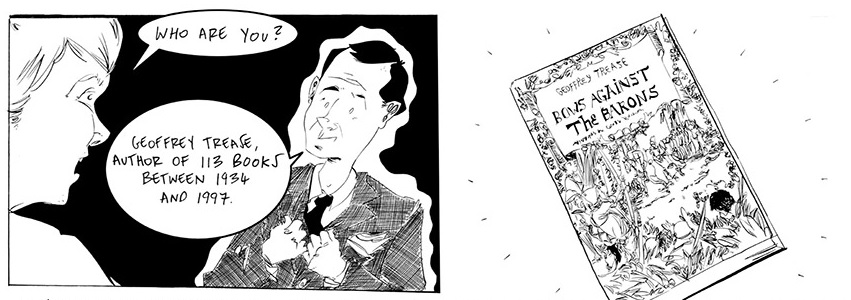
Geoffrey Trease features in Issue 11 of Dawn of the Unread

Geoffrey Trease features in Issue 11 of Dawn of the Unread

Directly opposite the Arboretum on Portland Street is the former home of Geoffrey Trease, who studied at the High School which you can find up the tramline leading out of the city. Trease produced an incredible 113 novels during his life before calling it a day at 88. He, too, was a rebel writer in that he was the first children’s author to give equal roles to both genders, offering historically accurate details to his stories that avoided the jingoism of the age.

Cityoflit510

Photo City of Literature.

It’s because of this rich history of positive rebellion that various organisations in Nottingham have partnered together to create Nottingham City of Literature. At the beginning of July we submitted our bid to be accredited as a UNESCO City of Literature. We find out on 11 December if we’ve been successful. But until then, why don’t you visit Dawn of the Unread, a graphic novel serial exploring Nottingham’s literary history. It’s taken over my life for the past sixteen months and will be finished in September time when we publish a physical version of the book.

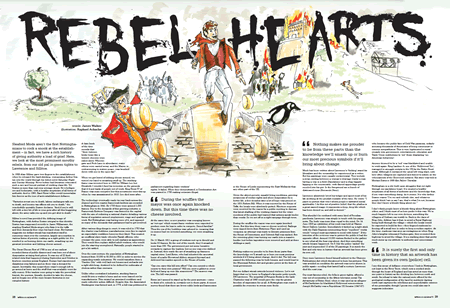
And if you want to learn more about Nottingham’s general gobiness over the centuries, check out my Rebel Hearts essay in Issue 70 of Leftlion.

RELATED READING