
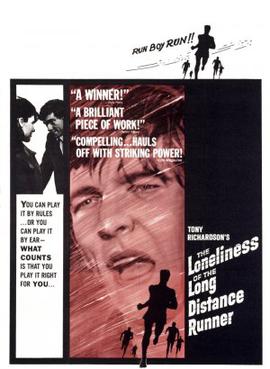
Theatrical release poster at Wikipedia.
This year marks the fiftieth anniversary of Karel Reisz’s film adaptation of The Loneliness of the Long Distance Runner. I’d originally planned to celebrate this by running the Great North Run with Tony Roe and then stopping at the finishing line and reading the story out aloud. A bit dramatic, but that’s the kind of thing you have to resort to when you’re trying to raise the profile of a voluntary organisation such as the Alan Sillitoe Committee. However, these plans were scuppered when I got the commission for The Space which has dominated the last six months of my life. It had nothing to do with laziness. ..
Loneliness was the title of Sillitoe’s second publication, a collection of short stories that also contains two other classics in Uncle Ernest and On Saturday Afternoon. I first read Loneliness in my late teens, which was probably the best time as I, like Colin Smith, was trying to figure out my place in the world. I still am. Through Colin Smith I learned that respect was something that was earned rather than a given and that it was alright to question authority, morals that have stayed with me throughout my life.
It was with great excitement, then, and a little trepidation, that I made my way to the Playhouse to see Roy Williams adaptation. Tom Courtney is as synonymous with Colin Smith as Albert Finney is with Arthur Seaton and so this was no easy task. One way to resolve this problem was by casting a mixed-race kid (superbly played by Marcus Romer) against the backdrop of the 2011 riots, which has raised similar questions regarding class and youth. This was a clever move and worked well.
The play included snippets of speeches by David Cameron, a politician certainly for turning given that he went from hugging a hoodie to hanging them. The aftermath of the riots saw incredibly harsh and disproportionate sentences handed out, particularly those regarding social media. It demonstrated a government completely out of touch with large proportions of society.
I agree with Williams that the questions Sillitoe was asking about Britain, then, are still as relevant today. However, I differ with his emphasis on greed in the riots. He said “the riots last year seemed to be very different to the eighties; they seemed to be more about a chance to get their hands on new trainers or whatever. We have this ‘fast-food’ culture where we are made to want things we don’t need and can’t afford. I think that was definitely an issue in the riots last year, and in a way that made it more disturbing because there was no cause.” This emphasis on the ‘fast-food culture’ has influenced his interpretation of Sillitoe’s story and as a result I think it loses the rawness and anger of the original, as well as Smith’s cockiness in the face of authority. But as a contemporary reaction it works very well.
The riots were instinctive – a mixture of boredom, opportunism and apathy. This is why some rioters showed such a lack of ambition in the shops they attacked – something alluded to in the play. It was more about the thrill of smashing something up than profiteering. Sillitoe writes about this in The Ragman’s Daughter, when a young thief derives greater pleasure from dumping his loot in the Trent and hearing it splash than in possessing things. Is there any better criticism of consumer society?
Sillitoe’s depictions of working class life are so brutal that he’s been accused of hating his own. But truth has always caused offence. This was why David Cameron was so harsh on the rioters as they were an embarrassment to Brand Britain, making us no different to the Arab Springs. No regime change under my watch.
Sillitoe wrote in his essay Poor People: “Voting can never make any difference to their plight. It would take too long. They want to get out of it now, this minute, this week at the most. When you live from day to day, how can you believe anyone who says he will alter things in a few years? The years ahead are an empty desert, without landmarks of any kind, beyond the imagination. Poor people live in the present.” Colin Smith certainly lives in the present as did the rioters. It was a guttural reaction to a malignant and offensive political system and one that will return with greater fury when 80% of the cuts kick in next year.
Other stuff.
- The Loneliness of the Long Distance Runner, Nottingham Playhouse, 23 – 27 October
- Interview with playwright Roy Williams
- I shall be tweeting LOTLDR (with images) to get you in the mood to see the play @thespacelathe or look out for #LDR2012