

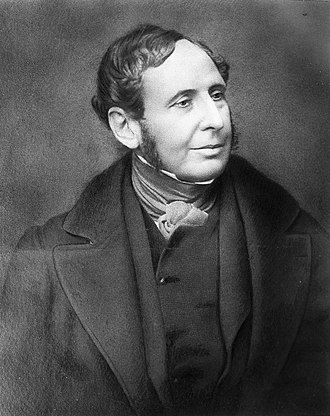
Robert Fitzroy, Captain of HMS Beagle. Photo wikipedia.
The maverick TV producer and author Harry Thompson died on 7 November, 2005 of lung cancer. The following day my mother died of the same illness. When I read about his death I went out and bought a copy of This Thing of Darkness, his debut novel which was longlisted for the Booker. It has sat patiently on my bookshelf waiting to be read – even accompanying me on three holidays – yet I’ve never got around to delving into the 729 pages detailing Charles Darwin’s five year voyage on HMS Beagle. So I decided to select it as my September book group choice and finally finished it on 17 September 2013, the day my father died of lung cancer.
I mention this strange symmetry as the real hero of the novel is Captain Robert Fitzroy, a man – who in the true spirit of the industrial revolution – saw the world as one large machine with God as chief foreman, dictating proceedings. Through this mode of thinking, Fitzroy believed that all life could be understood and various patterns predicted. He demonstrated this, quite literarily, through his navigational charts of Patagonia, Chile, the Falklands and Tierra del Fuego, which were so precise they were only updated recently through aerial photography.
Fitzroy realised that you could predict storms and general weather forecasting by locating air currents from the poles and the tropics before they collide. This was nothing short of revolutionary, and would go on to save millions of lives. Yet he still saw this rationalising of weather as part of God’s plan, as part of a system: “If God created this world to a purpose, would HE have left the winds and currents to chance? What if the weather is actually a gigantic machine created by God? What if the whole of creation is ordered and comprehensible? What if we could analyse how His machine works and foretell its every move? No one need ever die in a storm again.”
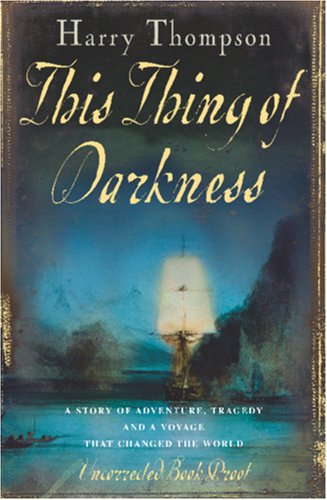
The American edition was renamed: To the Edge of The World.
There was one problem with his theory. It wasn’t profitable for fishermen to be sat on dry land and so the science of meteorology was ridiculed by businessmen able to exert political pressure. His storm warning programme for Britain, manned by three people, was eventually scrapped. It wouldn’t be the only ‘failure’ during his lifetime resulting from principles that clashed with profit.
Fitzroy was a Christian Tory who did not buy into the chivalric fantasy of imperialism. On his journey to Patagonia (Argentina), he brought back four Indians to England to be educated. His belief that Black and White people were equal was as radical as Darwin’s theory of evolution. Yet in his lifetime he was mocked for suggesting something so absurd. Equality did not bode well with Britain’s colonial involvement in these far flung territories as it made it more difficult to exterminate tribes and rob the ‘other’ of their land. Indeed, when it came to backing a genocidal campaign against the natives of New Zealand, George Grey, Fitzroy’s successor, was given twice his salary, triple his operating budget and a large force of troops. Fitzroy’s desire to spread the word of God would be ruthlessly manipulated by his successor who would eventually attack the Maori on a Sunday, when most of the recently converted natives would be showing their respects in church.
Fitzroy was bankrupt at the time of his death having spent his entire personal fortune subsidizing the public purse for what was ultimately the benefit of others. He and Darwin would both document their adventure on the Beagle but it would be the latter who would take the glory. Vice-Admiral Fitzroy would tragically take his own life in 1865. The loss of prestige and the death of his wife, along with his manic depression, would have contributed to his perception that he was a failure. He was nothing of the sort.
Overall I really enjoyed this book because it gave an insight into a part of history I knew very little about although I think it could have been split into two books. It’s thoroughly researched and a very easy read although it felt a bit like one of those BBC documentaries where all of the characters speak directly from diaries or first- hand accounts. This is very different, to say, David Mitchell’s The Thousand Autumns of Jacob De Zoet, whereby you can smell history without having it pointed out.
This Thing of Darkness is about one of the most remarkable journeys in living history. It captures the moment when science and religion properly clashed heads and the incredible careers of the crew aboard this relatively modest brig. But it will now signify the end of both of my parent’s journeys from an illness, like the authors, which cannot be predicted (unlike my parents, Harry Thompson never smoked) and is yet to be mapped out.
If you want to continue your nautical adventures then visit Aquatopia at the Nottingham Contemporary which runs until 22 September (check out the tentacle porn…) or follow @CDarwin and @Captain_FitzRoy on Twitter.
This Thing of Darkness is available from Headline Review for £8.99