About James

James specialises in digital literary heritage projects. He spends most of his time in front of a computer screen writing about life instead of living it. Therefore, do not trust a word he says.

Born in ’84

There are three voices that I drop everything for when I hear them on the radio: Will Self, Brian Clough and Dennis Skinner. Will Self because he is eloquent and articulate and because he sounds like he’s swallowed a dictionary. The ever quotable Brian Clough because he’s arrogant and charismatic and a hack’s wet dream. And the beast of Bolsover because he’s so passionate. I had the pleasure of hearing the latter give a tub thumping speech at The Winding Wheel in Chesterfield on Saturday 8 March to celebrate the 30th anniversary of the Miners’ Strike.

Skinner got a standing ovation, although at one point I thought he was going to keel over as he breathed fire into the ears of the attendant miners. I don’t necessarily buy into all of his arguments but l respect him because he stands for something, a rarity in today’s focus-led politics. He talked about the devastating effects of pit closures on local communities and believes that this is the reason for many of our current ills. He rightly stated that pits were a source of employment for ordinary folk who didn’t want to go and study, and that there aren’t jobs for people like this to go into, now that the manufacturing base has been destroyed. He also linked the closure of pits with the spread of hard drugs across estates.

I was ten in 1984 and had a very different experience of the strikes growing up in a pit village south of Nottingham called Cotgrave. It was full of drunken, angry men and violence was rife, particularly among my age group. Teenagers would actually come and knock on your front door and offer you out (fight). The population was largely Geordie, many of whom had relocated here in the early 1970s on account of Nottinghamshire pits being the second highest payers in the country. So there was already factions and tribes before the coppers moved in and families became divided on account of whether they scabbed or not. Then there were the skinheads who took over the local community centre and overturned the car of a social worker employed to keep them entertained. This happened more or less around the time that a disabled pit worker had their car over turned when trying to get to work. But my enduring memory was visiting one friend’s house who had no carpets and an old pop crate for a seat. I remember asking if he’d just moved in and he went quiet. It’s only now, 30 years on, as I read about the strike and visit events like this that the reality of his situation hits home. He was from a family of strikers.

When the artist Jeremy Deller introduced his Battle of Orgreave film a miner behind me moaned ‘these artists making money out of miners. It’s disgusting’. It did make me smile. Deller then confessed he went to a public school and was, of course, from London. But they knew he wasn’t one of their own and appreciated his honesty.

I spoke to Deller afterwards and he seemed like a well-intentioned and decent guy. I told him about my experiences of pit life and that based on this I imagined the re-enactment would have been really cathartic for the people involved.  The last thing they needed was a documentary analysing the fight. This was a lived experience. For this reason it was good to see the inclusion of a copper’s perspective and how over time he had come to realise things weren’t quite so black and white.

All of which brings me on to a book. I’m currently reading Look Back in Anger by Harry Paterson which is published by Five Leaves Press and thanks to the acute editing of Ross Bradshaw it delivers fact after fact about the strike, avoiding a ‘Mills and Boon meets Trotsky’ over simplification. There is no need to over describe what the police did or the effects it had on communities or why Thatcher is the anti-Christ. The raw facts are enough on their own and bleed out over the page. I’m hoping to interview Harry Paterson for the June issues of LeftLion and have a great idea for a topical front cover but more of this closer to the time.

Jeremy Deller’s All That is Solid Melts into Air is at Nottingham Castle until 21 April2014

Harry Paterson Look Back in Anger: The Miners’ Strike in Nottinghamshire 30 Years On, Five Leaves, £9.99


The Student Writers’ Toolkit

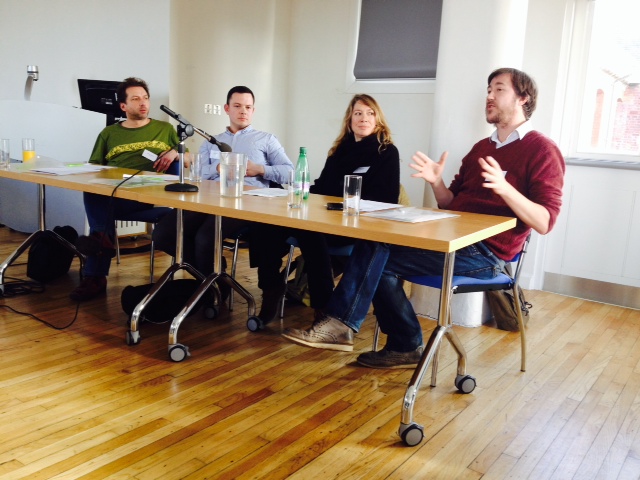
James Urquhart, Wes Brown, Mez Packer and me at Worcester University

James Urquhart, Wes Brown, Mez Packer and me at Worcester University. Photo Aly Stoneman.

This Saturday I visited Worcester to give a panel talk at the Student Writers’ Toolkit. I armed myself with a copy of Robert Shore’s Bang in the Middle, which attempts to define a character of the Midlands and asks a very pertinent question: Why has this region received such poor attention in the press when so much has happened here? It’s certainly having an effect on me because as the train moved towards New Street I didn’t moan about the Brummie accent and instead admired the incredible architecture that greets you, even that big shiny metal blob that wraps itself around a building and looks like the Gods have squeezed out a long strip of silver toothpaste.

The conference was organised by Jonathan Davidson of Writing West Midlands, a literature development agency. Don’t worry, Nottingham has its own version in Writing East Midlands which is run by Henderson Mullin and can be found opposite St Mary’s Church on Stoney Street.

My panel talk was about Writing Online and was chaired by James Urquhart of Arts Council England. The theme was: Writers were some of the earliest adopters of digital technology through personal computers and most writing is at least initially generated on a digital platform. And over recent years writers have responded ever more imaginatively to writing online. Log-on: discuss!

In many ways it was because of James Urquhart that I was asked to be on the panel. It was he who both made me aware of, and encouraged me to go for, The Space commission which materialised into The Sillitoe Trail and shaped my current fascination with digital storytelling. James is the Literature Relationship Manager at the AC and is based in Nottingham. Another reason to celebrate the Midlands.

I guess the thing I love about digital storytelling is the way it enables you to take multiple narrative threads into a story and offer a more complex layered understanding of a text. This approach is becoming increasingly important as users (once upon a time we called them readers) want to access content in shapes and forms that suit them. In many ways this has meant that an editor is becoming more of a curator, thinking about the ways in which different audiences will access smaller chunks of information.

My fellow panelists were Wes Brown and Mez Packer. Wes discussed the importance of digital legacy and how aspiring writers need to think less in terms of quantity and more in terms of quality. Those old blog posts that are either littered with typos or worst of all, drunken rants, will come back to haunt you if you don’t have a good tidy up. (Note to self: delete drunken rants about publishers letting you down and wanky agents who make you feel like a bunny boiler when you dare to ask them why they keep ignoring your emails).

Mez is the author of two books (Among Thieves and The Game is Altered ) published by one of my favourite presses, Tindal Street Press. As a senior lecturer in interactive media she was able to offer some pragmatic advice on how to use social media to create meaningful interactions with characters and how she put together interactive scripts for her transmedia storytelling experiment Reliable Witness, which was commissioned for the Birmingham Book Festival.

Some of the audience expressed fears about online plagiarism, but I really wouldn’t worry. First off, that great line that somebody has just stolen, well, you probably pinched it from an overheard conversation on the bus. It’s called Karma. Secondly, you have evidence that it’s your work the minute it’s uploaded and recorded, so if someone is stupid or lazy enough to steal it, they’ll get found out…but only if you’re successful. So take plagiarism as a benchmark of success and when you get a call informing you of intellectual theft, your career is heading in the right direction.

Another question concerned blog etiquette. There isn’t a perfect formula for this but my simple rules would be: Catchy title or one which show up on searches, no more than 500 words, be flexible where necessary (my excuse for writing this 900 word blog for those who are bored enough to be counting) use a strong photo/video at the top, be completely focused on one topic e.g. only write about your pet cat if your blog is called ‘stories about my pet cat’, check your spelling (which inevitably means there’s typos in this post. It’s the law to make a typo when you mention typos), link to other related blogs at the end of your post – to draw in like-minded readers, and finally, write regularly. My blogs at Dawn of the Unread are published every Monday. They are less frequent here because this website is just a general reference place.

Finally, a confession. Something I didn’t mention in my talk that I perhaps should have. I have done every job under the sun in order to be able to write. I am now in the fortunate position of being in a decently paid position which means that when I concentrate on projects in the evening I don’t have to worry about the bills. It’s because of this I was able to spend 9 months (unpaid) preparing for Dawn of the Unread. Writers thinking of embarking on complex digital projects that require much planning may not have the luxury of a full time job to pay the bills and so it’s probably best to build up a few regular contracts that will pay for bread and water before committing so many hours preparing a project that has no guarantee of getting funding. But the good news is even if it doesn’t come off, once you’ve fully thought it through and you’re gagging to get it started, you’ll find a way. And the answer isn’t always to do with money

Further reading