

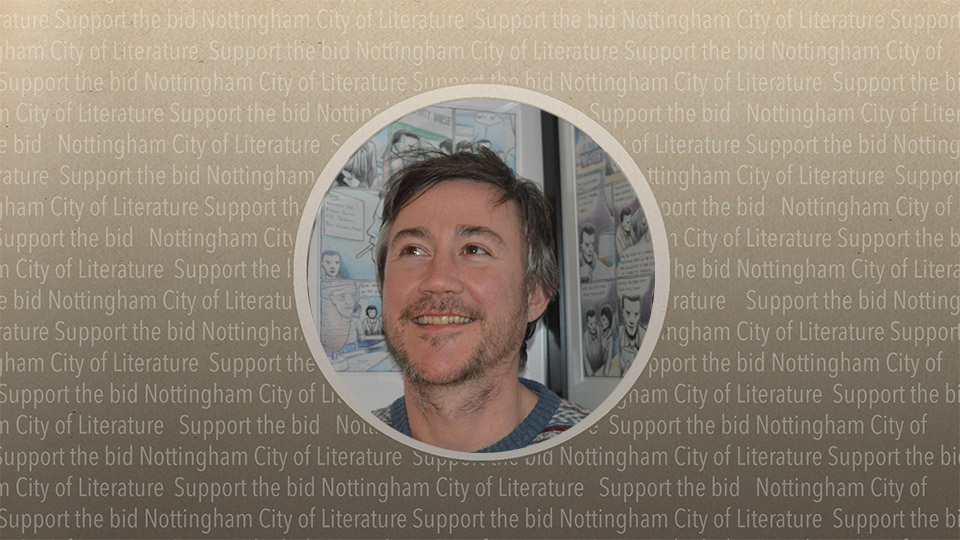
Photo by City of Literature.
Since Nottingham’s accreditation as a UNESCO City of Literature, we’ve had a silly amount of emails. Quite a few of these are from local organisations asking for a representative to come and give a talk about what the fancy title means and how they can get involved.
On 25 Feb I addressed the National Union of Teachers (NUT) for their Nottinghamshire and South Yorkshire branch. I snapped up the chance because the event was hosted at Mogal e Azam, an Indian restaurant opposite the Theatre Royal. I was lured by the offer of a free curry, which is the first form of ‘payment’ I’ve had since becoming a director of Nottingham City of Literature. But before you get all excited at my luxurious lifestyle, I had to pay for my own drinks.
The gathering was pretty much what you’d expect from a Union meeting; the highlight of which was hearing a request for an amendment to be made to an amendment. But on a serious note, there’s some pretty tough issues that teachers need to address. The most recent being the government’s plans to convert all schools into Academies. Needless to say the meeting over ran by an hour or two. When it was my turn to address the 20 or so teachers I managed about four words before being halted by the clatter of plates as the waiters – who, despite their job title, do not like waiting for people to finish what they’re saying – had begun serving up the mains. The food smelled lovely so there was no point having a hissy fit. We would continue after the mains.
When everyone was suitably bloated and tired, I took the stage. The audience has shrunk down to about eight people, with many having to shoot off due to childcare duties. This also included the host who had invited me over to give the talk. It was a humbling experience that I won’t forget in a hurry. Every time I look at the curry stain on my shirt that won’t come out, I’ll think: NUTs.
Joking aside, I was really eager to talk to the teachers because improving literacy is one of the City of Literature’s core goals. According to the most recent report from the OECD, Britain is now officially the most illiterate country in the developed world. This is why I positioned illiteracy as a form of child poverty in my Dawn of the Unread manifesto in 2014. Literacy levels are a particular concern in Nottingham as we are below the national levels. Therefore listening to teachers and offering them support is absolutely vital if we are to achieve our ambitious aims.
Certain areas of Nottingham need real support at the moment as they include high levels of deprivation and intergenerational worklessness and are really feeling the brunt of welfare reform. In the face of these challenges we’re committed to doing everything we can to help our children and young people achieve their full potential and learn the necessary skills to progress and become valued members of their community. We passionately believe that participation in creative learning activities, speaking and listening work, reading for pleasure, storytelling and storymaking and engagement with writers from all disciplines, is key to developing literacy as a core skill for all our young people. And that participation in shared literature-based activities is at the core of developing strong resilient communities.
Numerous research, in particular that produced by the National Literacy Trust, has shown the correlation between literacy levels and social outcomes. People with low literacy levels are less likely to vote, less likely to get married or be homeowners, and most worrying of all, have the least ‘trust’ in society. I could go on…
Teachers are under enormous pressure at the moment too. Putting aside the endless marking, long hours, and Ofsted inspections, they are also expected to teach to classrooms of increasingly diverse pupils. I witnessed this first hand last year when I took Dawn of the Unread to Djanogly Academy. I was informed by one member of staff that the school was 60-65% non English speaking as a first language. Therefore teachers are faced with the impossible task of teaching pupils from a broad range of countries who don’t even have language in common. Remembering that those non English speakers are from a wide variety of countries and so there isn’t even a second language in common. The result is boredom and apathy in the classroom as there simply aren’t the resources to give each pupil the individualised teaching they require. But I digress.
Low literacy levels, then, are not just about the diminishing attention spans of mobile-phone-obsessed youth. Not just about digital versus print media. But about language, aspirations, poverty, overcrowding, resources, pressure, support networks and multiculturalism.
The City of Literature team has now created a sub group headed up by Sue Dymoke which focusses on all issues relating to literacy. It’s a working group of around 30 people who work in various capacities within education and relevant sectors and was formed out of an open callout. Their findings will determine how we as a board go about achieving our literacy goals and implementing a strategy to support teachers, parents and children.
Complimenting this is the recently formed Cultural Education Partnership (CUP), a network of education, cultural, heritage and arts organisatons working together to address the inequalities in access to culture among young ‘uns in Nottingham. I attended their first meeting on Thursday 24 March and the most important issue raised was demand is more important than supply. In this sense, raising literacy levels isn’t just about flooding schools with writers but creating the desire for reading and writing from the pupils. For this to happen we need to listen to what children have to say.
RELATED READING
- Nottingham City of Literature website.
- Nottingham NUTs website
- Teachers consider taking industrial action with junior doctors over academy plan (Independent)
- Children’s literacy rates in Nottingham must improve according to City of Literature team (Evening Post)
- Young people in England have ‘lowest literacy levels’ in developed world says OECD (International Business Times)
- Britsh education in crisis? (independent)
- Sue Dymoke on City of Literature literacy sub group (Leftlion)