About James

James specialises in digital literary heritage projects. He spends most of his time in front of a computer screen writing about life instead of living it. Therefore, do not trust a word he says.

Making D.H. Lawrence videos in Canva

In January 1921, D.H. Lawrence and the ‘Q-B’ left Sicily for Sardinia. Six weeks later Lawrence penned his infamous travel book in which he puts forward a series of fanciful claims about the country he spent a total of nine days in. Lawrence is literature’s number one mard arse, raging against everyone and everything. He has made moaning an art form. The late Kevin Jackson described him as ‘the John Cleese of literary modernism’ in an essay I commissioned for Dawn of the Unread and Geoff Dyer applied what can only be described as ‘method writing’ when he imitated Lawrence’s restlessness in Out of Sheer Rage. Lawrence, however, is also incredibly perceptive, intelligent, and poetic, a writer quite like no other – though not for everyone.

Having read Sea and Sardinia numerous times, not least to mark the centenary of its publication, I created the above video which references Lawrence’s comical raging. There are eleven references to rage in the book, most of which are triggered by impudence – which gets fourteen references.

The video was created in Canva, a graphic design template programme which has a simple drag and drop interface. It has lots of themed templates for bespoke use – such as thumbnails for YouTube or banners for Facebook. It can be a bit clunky at times, but if you grit your teeth and think of the hours it would have taken you to come up with a layout, it’s worth it. My favourite feature is the fonts. There are so m-a-n-y…

Canva uses a fremium model, so you might want to subscribe to unlock some of the special features, but so far, I’ve managed to cobble stuff together via the basic subscription. You can upload your own images if you can’t find anything in their database and these can be animated, too.

In some respects, Canva is starting to have what I call the Wikipedia effect – I’ve used it for free so many times that I feel obliged to support them. Let’s hope I can actually get around to filling out an Arts Council form again…

In terms of identifying patterns in literary texts, this has become a lot easier with digitisation. The book is out of copyright and available online so you can copy and paste it into Word to find key words. To think that once upon a time, I used to go through a book with a highlighter pen…

This video is the 35th on the YouTube channel D.H. Lawrence: A Digital Pilgrimage.  
Representing student experience in a lockdown comic

If I believed everything I read in the press, during lockdown students were all having parties, getting fined £10,000 each weekend for breaking rules, and were solely responsible for the spread of coronavirus. This makes me angry because it’s very different to the experience I’ve witnessed working at Nottingham Trent University and Nottingham Trent International College.

The students I’ve spoken to have spent their 21st birthday behind closed doors, missed out on graduation, never met other people from their modules face to face, and feel anxious, not just about the virus, but what this means for their future.

It’s with this in mind, that I’ve spent lockdown talking to lots of students across disciplines and from different cities and countries. I’ve discovered that in Cyprus you have to carry a card around with you proving that you’re allowed to leave your house during set times; in Manchester, students have had security guards knocking on their doors to check there’s nobody inside; I’ve spoken to students who have remained in student accommodation because they don’t want to go home due to family problems; and some international students who have come here for one term as part of an international placement have spent it entirely inside their room.

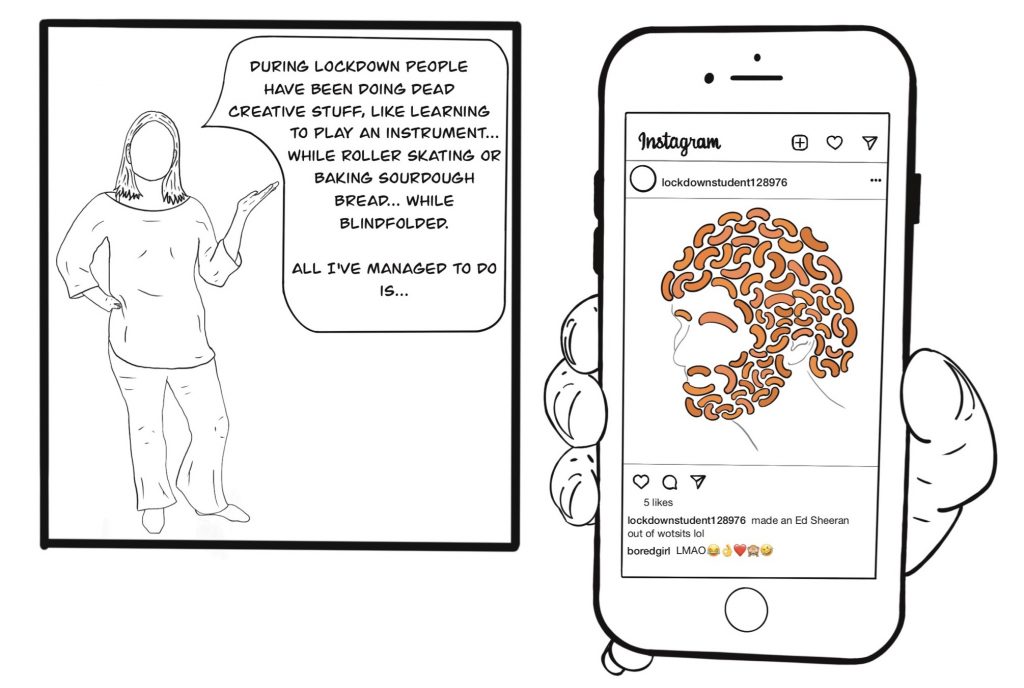
I want to address these representations in the next comic for Whatever People Say I Am, a series of online comics challenging stereotypes. The artist for the project is Lauren Morey, a Creative Writing student in her third year at Nottingham Trent. Lauren draws people without faces which seemed apt for a story about a group of people whose fears and anxieties have been largely overlooked by the media.

As part of the project, I’d like to include eight ‘pen portraits’ by students. Very simply, I want them to share their experiences of lockdown – whatever that might be. These will be published on the ‘Features’ section on the website which provides context to the comic. I’ve witnessed some wonderful strategies for keeping sane and trying to embed a sense of normality, from live streamed fancy dress parties in the bedroom to a silent disco on the balcony of flats.

If you have a story you would like to share of how you coped as a student during lockdown, please do get in contact. You don’t need to have sky dived off your balcony or learned how to speak dolphin. You just need to be honest about what you did and be yourself.

You can contact me here

This blog was originally published on dawnoftheunread.wordpress