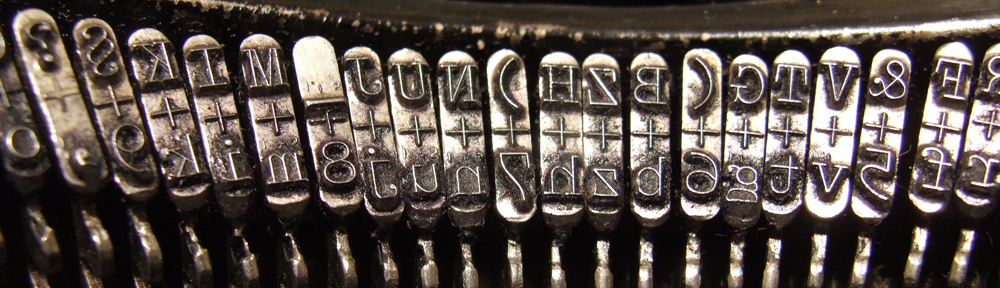

Photo James Walker.
Annelise Atkinson joined me at the Nottingham Writers’ Studio on the 18 January for a discussion on zines. Annelise runs the Caribou Caravan, a specialist boutique that makes and sells zines, cards, reconditioned typewriters and my personal favourite, cups with moustaches. The caravan is currently situated in Hopkinson’s Gallery but will soon be leaving to visit various arts and craft fairs up-and-down the country.
I invited Annelise to the studio for two reasons. Firstly, she’s an independent business and so needs as much support as possible. Being aware of various literature organisations and marketing herself more specifically to writers and readers could be essential for her survival. I’ve since been in contact with Ross Bradshaw to see if we can hold a similar discussion at Lowdham Book Festival. At first, I think Annelise was a little bit sceptical and thought I was after some kind of introduction fee for helping her out. Quite simply, I think what’s she’s doing is fantastic and I’d like to try and support her as much as possible. Independent businesses are closing down at an alarming rate in Nottingham – Lilly and Pinks being the latest – so unless we all pull together in whatever way we can, we’re destined for a bland city centre comprising of Tescos, Tescos and Tescos.

Inside the caravan. Photo by James Walker.
Secondly, it was an appropriate discussion for the studio as zines are a really viable option for writers at various stages of their career, something we tend to forget in the digital age. Zines offer collaboration with artists, encourage writers to be focussed through niche and specific topics, give experience of production and publishing, are accessible and affordable, can be used to promote work through spin-offs (thoughts from a character in your latest novel/poetry collection/extract from book etc) but most importantly, offer the opportunity of publication.
I was bought a Kindle for Christmas and I hate it. Functionally, it can’t be knocked. It holds loads of books and you can quickly search terms and phrases which are useful for research. But it’s an ugly brute. There is nothing magical or beautiful about it. Zines, on the other hand, are produced with love. They conjure the aura and essence that Walter Benjamin wrote of and are a reminder of the importance of the physical relationship we have when reading. Texture, touch and smell are just as important as words. That’s why we judge a book by its cover – and the kindle cover is generic.
Generally speaking zines take ages to make, any profit is negligible, they are produced in small runs and are read by a small niche audience. There’s something gorgeously futile about them – at least in relation to today’s values. But it would be a mistake to see them purely as an antidote to the Facebook generation as a lot use social networking websites for submissions or to promote work. Flicking through the zines reminded me of childhood and the excitement of waiting for my comic to come through the letterbox at 7am on a Saturday morning. You just don’t get that excitement with digital technology. You may have the world at your fingertips but there’s nothing tangible in your hand. That’s why there’s going to be a resurgence in zines. I hope.
Read an interview with Annelise Atkinson