Two incredible things happened in publishing today. Firstly, a nine-year-old girl called Martha Payne saw her blog ‘neverseconds’ published by Cargo while Penguin only sold 2,000 copies of Pippa Middleton’s Celebrations in their first week, remembering the talented wordsmith was given a reported £400,000 advance. Nothing should surprise you about publishing other than it will never fail to surprise: it is the very same industry that saw Katie Price out sell the entire Booker shortlist for a book she never wrote.
My book This is All I Know has reached a publishers desk twice (without an agent), been accepted and then nothing has materialised after a couple of years of pondering. It’s now sat on my alleged agent’s desk. I last heard from him about eight months ago when he requested one sentence chapter outlines so that we could work through some minor changes with the narrative. It’s incredibly frustrating, all of which makes me wonder whether there is any point bothering with an agent, let alone a publisher, in the digital age.
This was one of many issues raised through debates and discussions on #digitalsurvival at the Literary Salon which examined the way in which technology is transforming the publishing industry and making it easier for individuals to become their own publishing houses. Allan Gutherie, an author, literary agent and co-founder of publishing company Blasted Heath, argued the only possible reason for sticking with the traditional publishing route is vanity and if this is the case then you need to ask yourself why you are writing in the beginning.
Later on the snappily-dressed Ben Galley, author of the fantasy trilogy The Emaneska Series, put forward an inspiring case for self-publishing. Ben made his ebook available for free for a limited time and it had 10,000 or so downloads. When he charged £3.99 for his second novel he went on to sell 15,000 copies which is a remarkable figure, particularly given that Amazon authors can receive a staggering 70% of the sale price. It’s a very persuasive argument though I suspect that he has two advantages over say a writer of literary fiction. Firstly, his marketing strategy works because he’s written a series that need to be read in order and secondly he writes for an incredibly niche and loyal genre. But Ben’s biggest advantage is that he understands the industry and still has his work professionally edited. Too often self-published work lands on the LeftLion doorstep which is of a poor quality. The web works by word of mouth and can as easily destroy a career as forge one.
It’s also worth noting that gatekeepers have not simply stepped aside and handed over the keys to the democratic technorati. Amazon and Google give nothing away for ‘free’ (particularly tax) and come with a wide range of restrictions and implications that need to be carefully considered. A world with Amazon as the dominant publisher is as about welcome as another Tescos in the city centre. Back in Gutenberg land, Penguin has recently agreed a merger with Random House which may be good news for the Middletons but less so for independents.
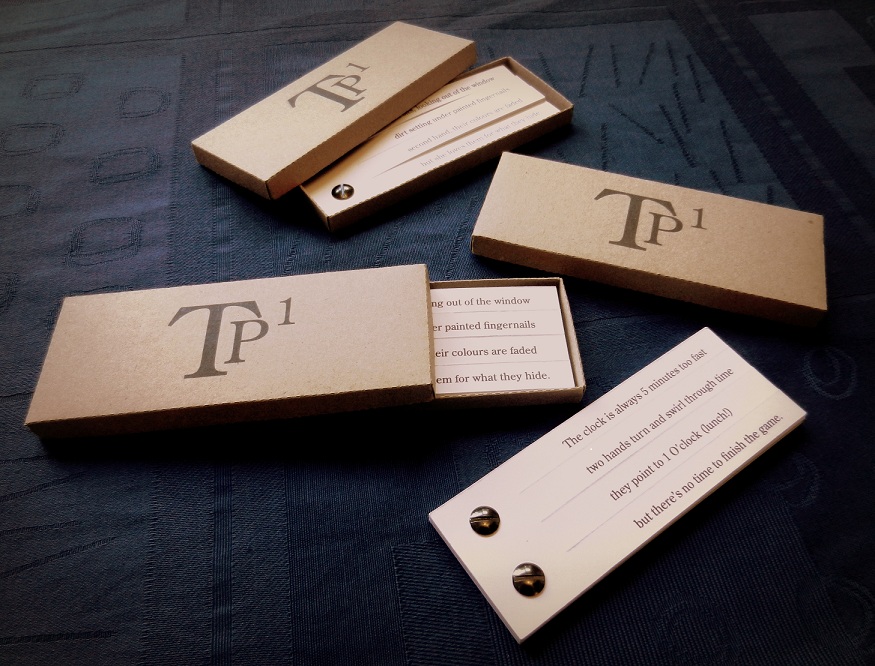
Tangible Publications ‘flat-pack poetry kit’
The publishing industry is clearly suffering from an identity crisis. They need to work out if they’re book sellers or multimedia content distributors. But one thing is for certain. The medium is the message. If you make a physical book then it needs to be a thing of beauty that appeals to all of the senses because these are all factors that influence purchase. Cheaply produced books with awful designs simply don’t sell. Similarly, if it’s digital then it needs to take advantage of interactivity. Why then do publishers simply duplicate text electronically instead of adapting to the respective medium?
It would be great to see a novel take on as many identities as we have online: to be a thing of beauty, a physical puzzle – such as Tangible Publications are trying, to be a traditional paperback of page and words, and finally to be a next generation digital book as outlined by Mike Matas. I believe this to be the future of publishing and I have more ideas on how it can work. In fact I have a book which we can use as a guinea pig.
The Literary Salon, Martin Hall, Loughborough University, in association with The Institute for the Future of the Book and Writing East Midlands, Friday 16 November, 6 -9pm Tickets £10 (£5 concession).
Interview with organisers Kerry Featherstone and Melanie Ramdarshan-Bold
 Beeston Poets are a joint venture between Nottinghamshire Library Services, Nottingham Poetry Society and Five Leaves Publications that brings well-known poets to Beeston Library. It follows on from the ‘Poets in Beeston’ series which started in 1983 and ran successfully for the next two decades. Of all of the roles that a library fulfils (keeping you warm, free internet access, reading LeftLion), perhaps the most important one is bringing authors and readers together, and thereby strengthening the library’s civic role through literature as determined by the Public Libraries Act of 1850. With the demand to shed 28 per cent from all budgets by 2014, drawing people into libraries has never been more important.