‘From the sea to the land beyond’ via Doc/Fest

The Queen was in Nottingham on the 13 June for a two minute wave on the balcony of the Council House. I imagined that she had been so impressed with Derrick Buttress’ Market Square Memories that she thought she’d chip down and take a look for herself. Unfortunately I was to miss this rain-drenched spectacle as I was heading up the M1 with Paul Fillingham to Doc/Fest. Tom Gatis very kindly offered free tickets to every organisation that had been commissioned by The Space, so we took him up on the offer.

The event we attended was called the Crossover Summit which explored new commissioning opportunities online and across other platforms; this included speakers from ARTE, The History Channel, Discovery, Arts Council, TSB, YouTube, the BBC, Channel 4, the Museum of London, Screen Yorkshire, the Wellcome Trust, the BFI and a panel discussing The Space. It was absolutely brilliant. All of the talks took place inside The Chapel and we were positioned close to the live Twitter feed screen which was oddly exciting. I’m slowly falling in love with Twitter and finding it the easiest way to make journalistic links, but more of this in another blog.

Most of the talks focused on new media which was really useful in thinking how we address the social media aspect of our Sillitoe commission. Three points in particular struck home. Firstly, that new media is biological in nature and adapts to its environment which made me think of the way our audience is interacting with our content. This point was addressed further by Steve Coulson of Campfire, the man responsible for the apocalyptic reality show The Colony, who described three types of online audience; skimmers, dippers and divers. Each category related to the emotional investment each user gives to social media. I am probably a skimmer, someone who is after minimal information whereas our Sillitoe project is trying to target divers, people who have an emotional investment in a project and go to great lengths to build up facts and attachments when online. The third intriguing point concerned reinventing data visualisation from Mint Digital who worked on the C4 experiment sexperience. This basically enables people to find out unique data from a national sex survey by blending together specific filters. For example, how many one-night stands do twenty-year old hip-hop fans have on average in South London or how many females in Norwich use nipple clamps. Perhaps due to the subject matter this seemed really fun but I did love the way that you could tailor results to your specific needs.

In all honesty, I’ve been a little disappointed with the interactivity on The Space. Yes, it does work across platforms and it does use a variety of art forms and it’s certainly given a more visible presence to the arts, but it does feel like a very slick website. At present, our interactivity takes place via the Silltioetrail website as there is a certain level of gatekeeping on The Space. I was expecting something more like the superb Channel 4 experiment Foxes Live, whereby the public has a more visible presence next to the content and there’s a greater sense of immediacy and presence.

But I wouldn’t be here if it wasn’t for the Arts Council and I wouldn’t be in the enviable position of constantly thinking about how to perfect a project if it wasn’t for the BBC. So I’ll shut me pan and end with a bit of magic. The Crucible hosted the world premier of From The Sea To The Land Beyond, which took us from the piers to the pavilions and the factories to the furnace on a 100 year journey of the life of the British coast. The film was directed by Penny Woolcock and accompanied by British Sea Power playing an especially composed soundtrack live. If our Sillitoe: Then and Now project is able to capture the changing face of Nottingham with just a tinge of the tenderness displayed here, our heads will remain well above the water.
Don’t let the BBC grind you down

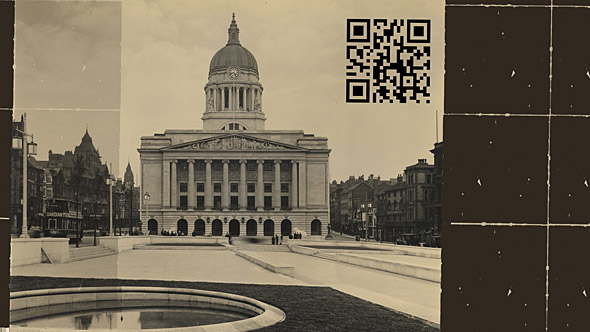
‘Market Square’ Sillitoe Trail artwork by Paul Fillingham.

The Sillitoe trail on the Space is visiting five key locations and themes from the novel Saturday Night and Sunday Morning (1958). Derrick Buttress has just had his fifth and final essay about the Old Market Square published. Now we move along to our theme for this location: ‘Don’t let the bastards grind you down.’

My initial idea was to see who the ‘bastards’ were in 2012 but this created absolute dread from my mentor at the BBC, Stephen James-Yeoman. He was concerned that I might open myself up to potential libel claims if people started ranting on about corporate conspiracy theories. Instead I adapted Arthur Seaton’s personal credo to the literary establishment, explaining how Alan Sillitoe and Derrick Buttress had transformed the literary landscape by representing working class people on their own terms. Half a century on from the publication of Saturday Night and Sunday Morning, the establishment faces a new challenge as authors happily work away at their own digital lathes, setting their own word-counts and publication targets thanks to that publishing button on Amazon.

Nottingham has a long history of rebellion against authority, particularly in the Old Market Square. The most recent visitor to show discontent here was the Occupy Movement. So I commissioned Christy Fearn, a local historical fiction writer, to talk to them before they left and see if she could find a correlation between their cause, Arthur Seaton’s and the Stocking-knitters’ demonstration of 1811/2 that she is currently writing about. She did this through vox pops interviews which were then put together as a short 4 minute film by Tony Roe of Inside Out. The film will now be shown through our social media channels to engage debate. This, again, was not planned. Originally it was meant for The Space itself but because they were moved on shortly before we started the project it felt a little disjointed. I was also concerned that the film didn’t accurately portray the movement due to the quality of people interviewed and therefore may have done more harm to their cause than good. But by using it through our social media channels we have widened the scope of our campaign and hopefully we will be able to continue the debate through Facebook.

I recorded a podcast with Christy Fearn and ‘Tash’ – a photographer who has documented protest movements for the past forty years. I thought the conversation was really interesting and raised some important points, most notably that the media does not provide an effective space for debate and that Occupy were filling that gap. Tash named a specific newspaper and suggested the reason for this was because they were so understaffed that they were forced to rehash PR briefs. I think he’s right but my mentor was worried that this was slanderous. He also felt that I didn’t interject enough to question Tash and therefore it was a biased interview. Consequently, the podcast got scrapped. This will only fuel further conspiracy theories from the Occupy movement that the mainstream media don’t provide a proper outlet for their opinions! This may be true to an extent but I have to take this one on the chin. It’s all John Humphries fault.

The final part of our first event sees Arthur Seaton reacting to the featured writers and themes. I had great pleasure writing this with Neil Fulwood and opted to call it ‘Seaton Rifles’ seeing as he would be firing off his discontent. But again the BBC were overly cautious, expressing concern at Arthur’s desire to blow up the Council House rather than camp outside it. This, of course, is a direct reference to the novel where Arthur mentions he would like to blow up Mortimer’s Hole. To lose this would completely dilute his character and render it unbelievable. I was sent a link to a BBC article about a man who was imprisoned for tweeting he was going to blow up a plane. I felt like I was in a Chris Morris mockumentary.

I don’t think for one moment that the BBC are actually that cautious. It was probably more the case that Stephen wanted me to properly think out every possible worst case scenario. His job is to scare the shit out of me so that I think before I speak. It works, sometimes. We receive mentoring on the Space in the hope that it will equip people with the necessary skills to go on and do future projects. It’s an absolutely fantastic opportunity, as long as you don’t let the BBC grind you down…