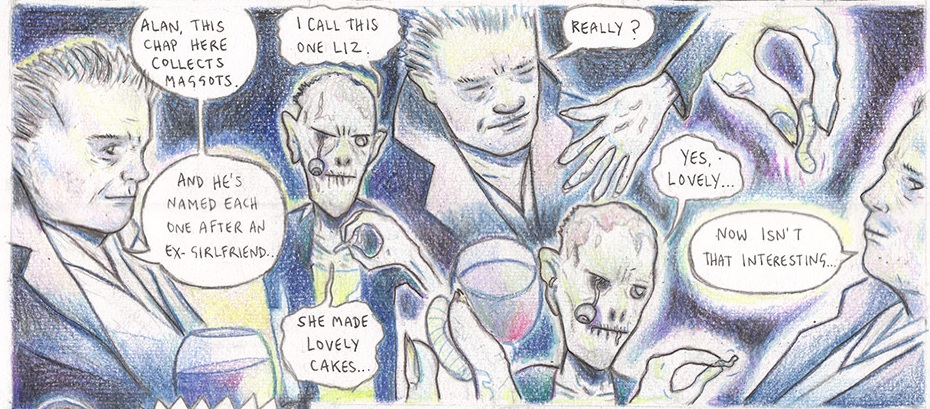


illustration: Natalie Owen in LeftLion.
I’ve been harping on about the importance of literacy for ages but never in terms of economic literacy. As we’re all expected to work zero hour contracts perhaps it’s about time we had a zero hour mortgage…
First off, let’s have a few statistics about the miserable mess we’re in. I’m not talking about Brexit, Trident or the prospect of Big Sam becoming the next England manager. I’m talking about two four letter words that define our lives: work and home.
According to the Ministry of Justice (MoJ) there were 10,732 repossessions of rented and mortgaged homes by bailiffs between January and March. Although this was down by 123 during the same period in 2015, it was up by 479 for the final quarter of 2015. But we should be grateful as The Council of Mortgage Lenders (CML) believe if repossessions continue to drop at the current rate we’ll be at our lowest annual numbers since 1982. Back when houses were affordable.
There are some reasons to be cheerful in terms of buying a property. The standard variable rate for a mortgage has plummeted and a rise in stamp duty has slightly halted property developers from swallowing up entire streets. But this has been offset by the ridiculous increase in house prices that simply make it impossible for anyone to save up a deposit, let alone get a mortgage. I bought my first home when I was twenty-one and it was roughly 3 times my annual wage. My current home is 7 times my annual wage. The house is the same size.
This may explain why rents in both the social and private sectors have risen this year by around 7-9%. The landlords who’ve had their wings clipped by the Chancellor are passing this cost onto those who can’t afford to get onto the property ladder. According to the MoJ there were 10,636 evictions during the first quarter of the year. Expect this to increase, as the cap on housing allowance kicked in at the beginning of April. Then there’s the 7.2million, according to Churchill Insurance, who have moved back in with the parents because a relationship ended and are too poor to rent alone.
For those without the luxury of parents, there’s the streets. You always know when the privileged are in power because the number of people ‘begging’ zooms up. On an average walk across town I probably get stopped between 5-10 times for ‘a spare bit of change’. Expect more of this as hostels, Citizen’s Advice, and public sector support service staff increasingly begin to evaporate.
What we really need is change.
Speaking of which, banks have a lot of loose change at the moment. They’ve saved a bundle in wages by adopting the trend set by supermarkets and kitting out their stores with self-service machines. The unidentified item in the bagging area is staff. People are losing their jobs in every area of work as technology slowly takes hold. Ring up for a taxi and you’ll no longer be put through to a call centre of eternally bored operators. Instead there’s an efficient automated service that tells you where you want picking up from before you’ve even said a word. And you know things are seriously wrong when Waitrose gets in on the trend and dismisses checkout staff in favour of self-service machines.
Banks need to cut back on wages because they’ve finally been caught with their pants down. According to the CCP Research Foundation the top twenty banks paid out £252bn in conduct charges over the past five years, such as the six banks fined a record £4.3bn for rigging foreign exchange rates and Lloyds £4bn penalty for mis-selling of payment protection insurance. So why exactly did we bail out the banks again?
According to the Sutton Trust, the poorest British students will graduate with debts in excess of £50,000. (In the US, by contrast, where students study for an extra year, the average debt at a private for-profit university is £29,000.) Although state-sponsored loans are linked to future earnings, these debts are subject to inflation so the money keeps going up. Students who studied a decade or so ago will tell you that although their debts were a lot cheaper, the loans have been sold off to debt agencies, despite the promise that they wouldn’t be, and now fear earning a penny above a certain threshold because it will trigger larger repayments.
For those of us fortunate enough to have a job there is the constant restructuring of departments and the shoehorning of two jobs into one, and for an added bonus, with reduced hours. Some of us have had our wages frozen for so long we have to put gloves on when we draw money out the bank. We’re told we should be grateful that we’ve got a job, and expected to smile when we receive the ‘Happy Friday’ email wishing us the very best for the weekend and remembering not to be late back in on Monday.
For adolescents who’ve skipped F.E. there’s the temp agencies where you’re guaranteed the minimum of work for the minimum amount of money. One lad I spoke to told me he had to drive to Grimsby to do a two hour shift and he wasn’t paid for his petrol or the four hours the round trip took. He had to do it because if he refused they wouldn’t consider him for other work. Work left him out of pocket. Of course this is completely illegal but it goes on all the time. ‘Calm down and carry on’ is the expression. This translates as ‘Shut up and do as you’re told’.
Zero hours contracts are the reality for most of us now. University lecturers are paid by the term and join an expendable workforce who can be got rid of with the flicker of an eyebrow. And this is where the Big Society steps in. The volunteers who run our libraries. The volunteers who cut down the forests. The volunteers who write for free for magazines because they have the deluded idea they can make a difference. So in some respects we’ve been complicit.
All of which finally gets me to my point. If we are expected to live flexibly in a big society on zero hours contracts, isn’t it time we had a more flexible mortgage, a ‘zero-hours’ mortgage, to reflect the reality of our lives?
A zero-hours mortgage would work exactly like a zero-hours contract. If there’s no work, there’s no mortgage payment. Simple. It’s not your fault that you’re losing your job in the call centre to the latest Siri. If you do work a few hours then you pay a proportionate payment. Yes, calculating this could be tedious but isn’t that better than repossessing a home and putting a family out on the street, which is ultimately more costly for society?
A university lecturer told me recently that universities need to throw out all of their liberal newspapers and stock the Financial Times. He said that’s where the power is, in the things people don’t understand. The things that are deliberately made complicated. For this reason he believes economics should be at the heart of everything that it is taught, no matter what the discipline. It’s for this reason that I’ve joined a reading group where we are slowly working our way through Karl Marx’s Capital Volume One, reading one hundred pages per week. It’s complicated, but far more humorous and literary than I would have imagined. I don’t believe in communism, and I certainly don’t believe in capitalism in its current manifestation. All I know is that something isn’t right at the moment and the system needs a bit of tinkering. Hopefully this book group – comprised of PhD students, unemployed, artists etc – and from Manchester, Mansfield and other places not necessarily beginning with M will help me figure it out.
The above article was originally published in the August issue of LeftLion magazine and The Axiological Perspective.
Sources:
- World’s 20 biggest banks rack up £252bn ‘conduct costs’ in five years. Sean Farrell. The Guardian. 18 July 2016.
- Conduct Culture People Research Foundation
- Degrees of Debt Dr Philip Kirby April 28, 2016 Sutton Trust
- MOJ Mortgage and landlord possession statistics 8 Aug 2013 – 13 Aug 2015 Government Statistics
- Generation doomerang: moving back in with mum and dad. Helen Nugent. The Spectator 11 May 2016