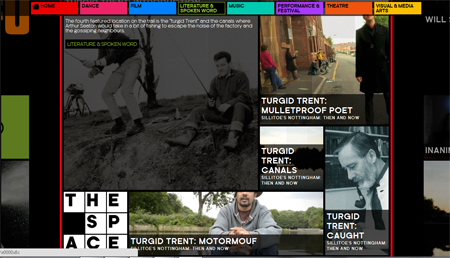
 Arts Council England published its Creative Media Policy in July 2012 and within this, they’ve committed to a future legacy for The Space pilot project. This is fantastic news as it means that us guinea pigs producing content must be doing something right.
I’ve been so involved in the Sillitoe project that I’ve not really had time to reflect on what might happen with the content or how it would feel to see it all suddenly switched off on 31 October when the project finishes. So I’m even happier to announce that “both the Arts Council and BBC believe that it is imperative that The Space retains a digital presence after the ‘switch off’ date.” Both organisations have committed to maintaining their support for the project in its current form, and to extend the pilot to the 31 March 2013 in order to create more time to explore the potential of a permanent service.
There’s been lots of teething problems on the way. My main gripes would be videos not playing or freezing when being streamed, lack of interactivity between producer and consumer, errors in uploading content (such as missing vital paragraphs from text documents), font sizes that work on large screens but not so well on mobiles, and the lack of control that project editors have over the production and appearance of their work, but these are minor issues in the grand scale of things and all issues that can be resolved.
An example of this would be projects being limited to how many articles or files can be grouped together on a holding page. Now they’ve mastered this it removes an unnecessary restriction on editors who can concentrate on producing content that they deem best for their project rather than content that fits into the needs of the programmers. The holding page now looks fantastic and means that viewers can more easily be drawn to similar content. This is a massive progression and deserves a big thumbs-up given the scale of the project and the inevitable demands this entails.
The programmers and curators need time to sit back and reflect on how best to address the various issues outlined above but it would be a great pity for the content to simply disappear as I’m sure it could be tweaked as they go along which seems to be the general idea. Therefore there is also talk of a further option to renew this extension for a further six months, from the 1 April 2012 to the 30 September 2013. This decision will be taken in early January 2013. Needless to say we’ll be delighted to see Alan Sillitoe spend a little longer in the technological void.
The only downside to all of this is we might have to faff about a bit with existing contracts or in the worst case scenario, The Space may choose to remove our project. There is also the depressing matter of clause 3.8 which means we cannot financially benefit from the project until the end of 2015. As the whole purpose of the project was to raise awareness of our statue fund and none of this is for personal gain, it would be great if we could charge 50p per mobile phone app download. Hopefully we will be able to find a way to resolve this issue as well.