Journalism workshop at Nottm Contemporary

Photo by Pixabay at Pexels.

Today I held the first of four workshops on magazine journalism at Nottingham Contemporary. One of the opening tasks was writing for a specific audience. The class had to write a review of the building for the Sun, Mail or Guardian. In preparation for this I gave them an extract from each paper reviewing the Turner Prize and we selected certain phrases that captured the style of the publication.

The Sun focussed on Rebecca Warren’s ‘display of litter’ that ‘was picked up from the floor of her studio’ suggesting a flippant, casual uneducated piece, subtly rubbishing modern art in the process and telling us what we all like to think – it’s a load of pish made by workshy middle-class dropouts. The quote they pulled from Rebecca made her sound completely incompetent ‘for somebody it could mean one thing and for somebody else it could mean something else’. As much as I detest Murdoch’s runt of a child, you can’t help but admire the Oxbridge journos that pen these words. Absolute genius. Allowed the artist to hang herself whilst opening up the high/low culture debate without a sniffle of pomposity.

The Mail managed to hype things up to boiling point by focussing in on the ‘ripped paintings’ and ‘serial killers’, using the coveted art prize as yet another vehicle through which to scare the living shit out of the population and demand the return of the birch to restore order. But boy do they do condescension well. They managed to make Susan Philipz sound like a cross between an escaped X-Factor convict and a troll. ‘A woman known for singing through a PA system at a branch of Tesco… and under bridges’. Hilarious. And not a mention of her art.

The Guardian offering was as liberal as ever, promoting ‘culture from below’ by asking ‘Wot, no Bansky?’ and giving a more balanced appraisal. It was great fun deconstructing language and reminded me how easily you can build up a profile of someone through just a couple of carefully constructed sentences. Odd that in teaching this it suddenly hit home.

In preparation for writing their own pieces, the class wandered around the building taking notes. The corrugated panels to the exterior of the building (or the Anderson Shelter as locals refer to it) is partially covered in lace. It made me think of an old tart pissed up around town, necking back her WKD in ripped tights and mini-skirt. Then when you realise that the gallery is next door to the Pitch ‘N’ Piano, a church converted into a pub, it suddenly becomes a place where everything is trying to be something it’s not. Nottingham could be accused of a similar form of deception, thinking it can accommodate this cultural behemoth into the landscape. Whatever our interpretations, the point is there is detail everywhere. The key is finding the correlations and then putting it in a style that will appeal to a particular readership.

I should note here that the reason I am so fascinated by detail at the moment is because last week I attended the Stanley Middleton Celebration, the Booker winning Notts author who died recently. The former teacher was a master at small detail who would often ask students to look out the window and describe what they could see. ‘Look at the wind, what direction is it moving in, what’s it doing to the tress, what noise does it make, look how it’s blown that woman’s hat into a puddle, look at her reaction etc. Gawd bless him.

The main function of this blog though is not to give away free journalism workshop ideas to them that can do me out of work. It’s a test. After discussing the importance of writing a blog to gain an online presence and to discipline yourself to write, I wonder how many have checked this out – to see if I’m good to my word or simply to do a bit of prying. If you are one of my students reading this then you can successfully tick off ‘intrigue’ as one of your essential journalistic traits.
Bookshelf Envy

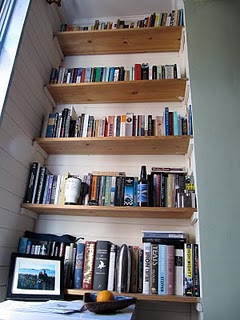
Photo by James Walker.

Usually my bookshelves are a place of complete order, the kind of categorising which would make a Victorian blush with pride. In its heyday, this entailed novels shelved according to genre/movement/themes. Naturally these ran in alphabetical order apart from my history section, which was filed according to conflict. I am somewhat ashamed/proud to admit that even the shelves were implicit in the archiving as the books generally ascended from light hearted at the base (comedy) to more serious issues (biography/academic) at the top.

But sadly this isn’t the case anymore as I have moved house too many times and am yet to afford myself the pleasure of this obsessive Hornbyesque type ordering. But it will happen. It always does. It’s just a matter of time. And the problem will get worse because the more I read the more I create new categories and realise that some books fall into at least three of these. Does this mean I need to start purchasing multiple copies? Oh dear, that’s a bad thought.

The photograph I’ve attached is from my dining room and has two symmetrical shelves. Who knows what the future will hold, perhaps American literature on the left and European on the right. Time will tell. But for now there is no logical order. I’m learning to let go. I do still require some order and have a ‘review’ section scattered on my bedside table to remind me they’re important and need immediate love and attention. Talking of love…

Selecting five books from these shelves is a difficult task, like asking a parent to name their favourite child. You may know the answer to this in your heart but it’s something you’d never publicly admit to. If you asked me this question in a week or so the list would no doubt change again. In fact I’ve realised I haven’t included The Life of Pi, Betty Blue, The Outsider, Papillion, The Secret River and the ultimate pulp anti-narrative, England Stories by Tim Etchells. I‘m sorry. I love you all the same. Honestly…

Defying Hitler by Sebastian Haffner
‘The first country to be invaded by the Nazis was Germany’ and so begins an alternative cultural and historical analysis of the rise of Fascism. I’ve read all perspectives of the Great Wars from Primo Levi to Antony Beevor but this one really hit home because it showed how everyone was implicit, right down to the office workers who were too afraid to refuse to produce the legal paperwork that made the horrendous atrocities legal.

Dirk Gentley’s Holistic Detective Agency by Douglas Adams
Each girlfriend that I’ve been serious about has been presented with a copy of this book and warned, if you don’t like it, we simply won’t get on. An absurd surreal quantum detective novel, it’s quite simply the finest example of how to produce perfectly balanced sentences. It’s also very funny. I cried when Douglas Adams died. I still think of him a lot now. No-one captures the wonderful absurd beauty of life as he. My favourite character invents a time machine so that he can go back in time to watch programmes he’s missed on TV – as he can’t figure out how to programme his video recorder. Genius.

A Man of his Time by Alan Sillitoe
In the tyrannical figure of Ernest Burton, Sillitoe has created arguably the most powerful despotic figure ever to grace the pages of literature. ‘Burton’ – as he is known by all – is a hard grafting Blacksmith who reigns over his eight legitimate children with an iron fist, demanding loyalty and obedience through a mixture of fear and hatred. If you want to know why Arthur Seaton (Saturday Night and Sunday Morning) turned out like he did and why kids these days ‘don’t know they’re born’ read on.

Captain Corellis’ Mandolin by Louis de Bernières
When I split up with my previous girlfriend – soon after she confessed to not liking Dirk Gently – I went to Kefalonia to read the novel in its natural setting. I couldn’t put it down and was gripped by the amazing, complex love story and the innocence of people thrown into awful circumstances. It also taught me about writing and how important it is to layer a plot to keep the reader intrigued about the resolutions of many characters.

Cold Mountain by Charles Frazier
Yet another historical, romantic novel. Maybe I should start giving this to girlfriend’s instead? My friends had been begging me to read this and like any stubborn male worth his salt I ignorantly argued it was soppy romantic trite. How completely wrong I was. Set to the backdrop of the American Civil war it follows a soldier returning home to his love who in his absence, has built up an amazing friendship with another woman. A tale of endurance and coping in difficult times that will make you cry. Thelma and Louise for those with a historical fetish.

I guess one thing which unites all of my choices is how our environment shapes us and the relationships we have with each other. My environment is one of books and always has been. There are a million friends and situations stacked up and down the three floors to my house, all offering advice and a vast range of emotions. Like writing they open up worlds and offer refuge. Mine is a warm welcoming environment which always finds space for new friends. Megan Taylor and Rod Maddocks are the most recent. Listen to them tell their story on my literary podcast WriteLion 5# or better still, come down and have a chat yourself.

The following blog entry was published with Un: Bound, a great feature where they get writers to discuss their books and the shelves that home them. My suggestion for future book loving bonding is: Your five favourite characters from literature and books you need to read in the country in which they were set. Hmm.