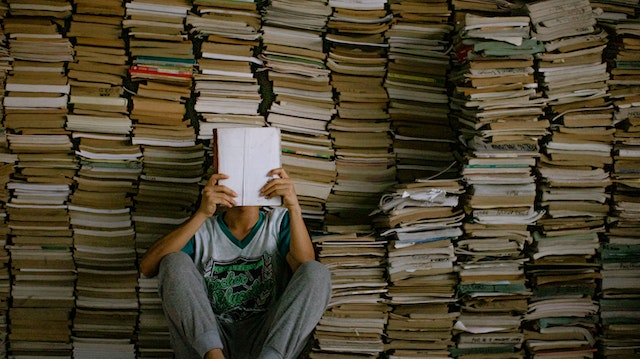
Photo by Nothing Ahead at Pexels.
Writers, academics and publishers from the East Midlands have come together to write a letter of protest to Nottinghamshire County Council over its planned reductions in library staffing, opening hours and a 75% cut in its book fund. Within 24 hours of the letter going public 76 writers had signed the letter with the target of 100 in sight.
Those supporting the letter include well known local novelists including crime fiction writers John Harvey and Stephen Booth and children’s writers Gwen Grant and Helena Pielichaty. The list includes Julie Myerson, a major novelist who spent her early years in Nottinghamshire and who used to work in the local library service. Others include Eve Makis who, with Stephen Booth, acted as Nottinghamshire Reading Champions in 2009 during the National Year of Reading, aiming to bring more people into libraries. The list of writers ranges from novelist through to academics, and from fantasy writers to poets.
The letter was drawn up by Ross Bradshaw, of Five Leaves Publications, whose own career started in libraries and who was for ten years the County Council’s Literature Development Officer. He said “All the local writers I have talked to have been shocked at these proposed cutbacks. Councillor John Cottee, Cabinet Member for Culture, said that ‘We [the County Council] are committed to libraries being at the heart of the community’. If so, this is a heart attack. 100 writers and publishers responded within 48 hours.
Children’s writers in particular are astonished at these cutbacks as they know more than anyone how important libraries are in children’s lives.” He added “these cuts seem particularly thoughtless as the previous administration at County Hall had invested a lot of money refurbishing many libraries – including Eastwood, Southwell and Arnold – making them into beautiful libraries for the 21st century. The current administration plans to reduce their hours, their staffing and the number of books.”
The letter will be sent to Nottinghamshire County Council on Monday 25th October and will read…
Nottinghamshire County Council has announced major cutbacks in staffing, opening hours and in the book fund of libraries throughout the County (details below). All of us have used our local libraries in different ways – for research, for pleasure, for events with readers – and we know how valuable libraries are for children and adults. We are a group of writers, publishers and professionals working one way or another with books in the East Midlands and are appalled at Nottinghamshire’s decision.
This will have a major impact on the whole community, from business support to levels of literacy. The Cabinet Member for Culture and Community at Nottinghamshire County, John Cottee, says that ‘we are committed to libraries being at the heart of the community’. Maybe, but the Council’s action shows a different view. These cuts will drive down library usage and will deter visitors and investment as Nottinghamshire will be seen as somewhere with little concern for reading and culture. We urge a rethink.”
Paint a vulgar picture: The ugly facts.
- Staffing cutbacks of 83.4 full time equivalent posts
- Reduction of opening hours including one day a week for the bigger libraries, two days a week for the next level down
- 28 smaller libraries to become “community partnership libraries” on reduced hours
- Mobile libraries to cut their visits to once a month
- Book budget to be cut by 75%
- The life of a book to be extended from an average 5.4 years to 21.5 years
“In times like ours, and perhaps in any times, it is a crime to take away access to libraries, which do so much good, and especially to cut services which affect those who can least afford to replace what a library provides. Like a canary in the proverbial coal mine, libraries are the delicate and lovely thing whose fate tells us whether what we value about our society is going to survive.” Eireann Lorsung, poet
“As a children’s author who visits schools, I know that library cuts will affect children from poorer families who can’t buy books.” Caroline Pitcher, children’s writer
“The library was a lifeline to me growing up in Nottinghamshire. As a young teenager, I got through about 6 novels every couple of weeks. I still remember the authors I discovered. At 16 & 17 I’d go there on Saturdays to flick through the Writers & Artists Yearbook and dream of being published!” Julie Myerson, novelist
“Libraries aren’t just the heart of a modern society they are its mind and its soul. Libraries’ unique ability to promote and exchange ideas and imagination to every part of our society should be safeguarded at almost all costs. Libraries are a signpost to a better life, a life where understanding, tolerance, empathy, co-operation and community are held in the highest esteem. If that direction is diminished in any
way, it will be a loss to every part and, more importantly, to us all.” Paul Reaney, football writer
“I have made extensive use of public libraries for a current book project, including using the interlibrary loan service to obtain many hard-to-find volumes which I otherwise would only have got to see by making regular trips to London to use the British Library. Writing my book would have been both more difficult and considerably more expensive without this facility, which is just one of the many important and vital services offered by our public libraries.” Mark Patterson, writer and journalist
“Some of my happiest childhood memories involve library books and visits to public libraries – they were at least as important to my education as anything I learnt in school.” Kathy Bell, academic and poet
“I look forward to paying my council tax next year. With all these cuts to services, it should only be £2.34” Moi, paperboy