Never judge a book by its judge…

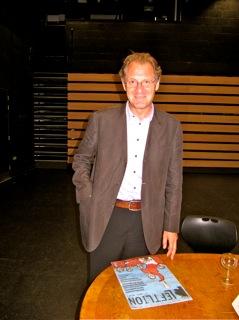
Andrew Motion. Photo James Walker.

The winner of the Booker has never been easy to predict with the outsider often pulling off a shock. Take DC Pierre’s victory in 2003, who would have thought that such a populist narrative (imagine Jerry Springer on death row) would ever get the nod above a literary goliath such as Margaret Atwood or Monica Ali’s Brick Lane, which ticked all of the right boxes with her tale of multicultural life in the capital. Another notable exception to be usurped was William Trevor who lost out to rookie Yann Martel a year earlier. If anyone deserves the golden toaster of recognition for services to literature, it’s our Trev. But it does suggest that the Booker is free of cultural bias and favouritism, although the conspiracy junkies will tell you its very ‘unpredictability’ is evidence of foul play.

Perhaps it’s not the books we should be looking at then, but the judges. They have, after all, been selected for their suitability – although the selection of some panellists is arguably as controversial as the winners. Was it any surprise that Conservative elder statesman Douglas Hurd plumped for Ian McKewan’s Amsterdam? Who else would even care, let alone identify with, the misadventures of a foreign secretary, composer and newspaper editor? It was a self-indulgent status-dropping yarn, written for the inner circle. Then there is that other great bastion of the written word, Michael Portillo. When he opted for Aravind Adiga’s The White Tiger he was offering the world an insight in to a corrupt Indian ‘told you so’ society, whilst proving – without any reasonable doubt – he was a nice guy Eddie, a man of the many different types of people of GB Ltd, and nothing like those ghastly Spitting Image caricatures. ‘I hope you all feel guilty for getting me wrong’ was the subtext.

When Lisa Jardine, the former protégé of Raymond Williams (CV: founding father of British Cultural Studies), crowned the Life of Pi literary king, she was admiring his humanitarian observations of the human condition, such as the need to respect difference and how to live in harmony with Others. Then there is last year’s winner Wolf Hall. Hilary Mantel’s speculation of political life would no doubt have pleased Radio Four’s James Naughtie, who in The Rivals and The Accidental American has exposed the ‘lark tongue’ shenanigans of the New Labour courtiers.

So let’s speculate about this year’s chosen ringmaster, Sir Andrew Motion, a curiously contradictory figure. On one level he is firmly a member of the establishment after his tenure as Poet Laureate and all that Lady Di hype. He also has a presence – in some capacity – on some of the most significant cultural organisations in the country. But he’s also a self-confessed ‘old school leftie’ and still a party member. In person he is softly spoken, awfully polite, and strikes you as a man of integrity. But then according to some critics this is another contradiction, less we forget the ‘Larkin betrayal’ and that affair. But it is the loss of his mother after years in a coma that has had the profoundest affect. To be physically present yet unable to communicate on a meaningful level has, I believe, shaped his psyche. The book that taps into this will win on Oct 12th.

This blog was first published for Nottinghamshire Libraries Booker debate
Alan Sillitoe

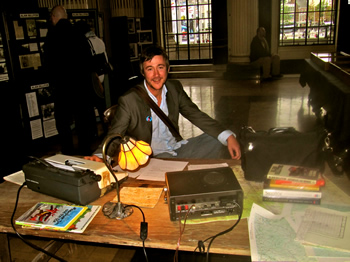
At Alan Sillitoe’s desk.

I have a few very happy memories of meeting Alan Sillitoe but one stands out in particular. It was in 2008 when he came up to the Broadway cinema for a conversation interview on stage before the screening of Saturday Night, Sunday Morning. I was sat in the lovely Paul Smith designed seats with Al Needham, desperate to ask him some questions in the small Q&A session that followed.

When the Q&A started an old man put his hand up and said ‘Excuse me Mr. Sillitoe, could I ask you a question? I was on holiday in Australia the other year and I found a book that had your name on it and I was wondering if it was also by you?’As the audience gasped at this calamitous faux pas, Sillitoe grinned away and politely asked him the title. The man produced the book, read it out, and sure enough it was one of his 66 books.

The man was absolutely delighted and waffled on some more about how he figured it might have been by him but wasn’t too sure how many books he’d written and how they came to be abroad. This took a good five minutes and just when we thought he had finally finished, he said ‘could I ask one more question?’ This time the audience’s frustration turned to laughter, accepting that this quite innocent man was oblivious to their desire to ask, shall we say, more pertinent questions.

Sillitoe obliged and the question followed. ‘Please would you sign the book?’ Sillitoe smiled, perhaps relieved at not being asked the usual questions he’d had to endure over the decades and said yes. Before he could explain that time had been allocated for this after the Q&A, the man began shuffling his way along the row of seats and made his way onto the stage. At this point everyone was in hysterics.

What I witnessed that day is something I wouldn’t have found out if Sillitoe had gone through the formalities. Here was an author who didn’t take himself too seriously, who had time for people, and could find humour where more egotistical authors would have become angry. I shouldn’t have been surprised really, particularly given that this is the same author who instructed his publishers not to enter him for any literary competitions.

As it turned out I was able to get a more in depth interview with Sillitoe which, according to the Independent, was his last. A strange honour in some respects but something I’d certainly have traded in to read his words for one more time.

It is for reasons such as this that myself and various other members of the Nottingham writing community have spent the last three months working tirelessly and for free to put on the Celebrating Alan Sillitoe day on the 2nd October at the Council House, which saw DJ Taylor, John Harvey, John Lucas, David Sillitoe and many others celebrate his vast and varied work. It was part of an ongoing project that is hoped will raise money for a statue to be built in Lenton.

We have other events lined up which include an Alan Sillitoe beer (the first of many about local celebrities by Castle Rock), a curry and talk night at the White Horse (to be given by different writers), a short story competition that sets Arthur Seaton in the present and a literary walk.

I’d hoped to blog about how we organised the event, problems we came across and general advice for others hoping to put on an event at such short notice but I’m absolutely knackered and so this entry signifies the end of a long but enjoyable process. Instead, I leave you with this interview with Alan’s humble and unassuming son, David.

For more on the event, please see the Sillitoe website